Mosque Foundation | Bridgeview, Illinois Logo
Mosque Foundation | Bridgeview, Illinois

Mosque Foundation

Muslims In China

First Friday Prayer is at 12:30pm. Second Friday Prayer is at 2:00pm.

Muslims In China

Tjweed Class For Men

التلاوة العمليه للرجال كل يوم جمعة بعد صلاة العشاء مباشرة

Jerusalem, Trump and Deliberate Deceptions

  As Donald Trump won the American presidential elections, Heiko Maas, the German Federal minister of Justice and Consumer Protection noted: “Die Welt wird nicht untergehen, sie wird nur noch verrückter” (The world is not going to vanish, but it will get crazier). As Trump’s administration acknowledged Jerusalem as the capital of Israel on December 6, 2017, one could easily discern that there is profound wisdom in Maas’ evaluation, at least in the long run.

The world will get crazier as this announcement deliberately and grossly distorts history.  Some refer to ‘the natural, historic right of the Israelis in Palestine’ as a justification for the occupation of Palestine, the expulsion of thousands of Palestinian people, the destruction and depopulations of hundreds of villages and the ongoing establishment of settlements since 1948, the year which marks the Palestinian Nakbah or Catastrophe. In the reference work All That Remains: The Palestinian Villages Occupied and Depopulated by Israel in 1948, edited by Walid Khalidi, you find a detailed description of more than 400 Palestinian villages that were destroyed or depopulated by Israel in 1948. Names of these villages are removed from contemporary Israeli maps, yet, these names are engraved in the hearts of those Palestinian refugees and their families as their real homes that once they were evicted from due to the massacres, fear and panic incited by the Zionists. For instance, the Israeli historian Shlomo Sand admits that Tel Aviv University lies on part of what was once known as the village of Shaykh Muwannis.[1] Furthermore, immigration waves of European Jews who own no inch in Palestine were subsequently facilitated to replace the Palestinians and to change the demography of the country by force.

Currently, many Israeli historians dare to speak out, refuting and exposing many of the myths of Zionism, such as Ilan Pappé in his The Ethnic Cleansing of Palestine. Ilan Pappé belongs to the movement of New Historians who challenge the traditional versions of Israeli history. This movement includes Benny Morris, Avi Shlaim , Tom Segev, Simha Flapan, and Shlomo Sand. Many American Jewish leaders spoke against Zionism; such as Alfred M. Lilienthal and Elmer Berger, the executive director of the American Council for Judaism (1942:1955), and professor Norman Gary Finkelstein.

Historically, the existence of Palestine is pre-biblical. The Jews were not the original inhabitants of Palestine. “The early inhabitants were semi-nomadic tribes, but about the 20th century B.C. the Canaanites began to settle in the plains and on the coast. They built villages and towns and developed their own culture. In the Bible the country is called ‘the land of Canaan’ (Numbers 34:1, 35:10) or the ‘the country of the Canaanites’ (Exodus 3:17).”[2] So the city was founded around two thousand years before Abraham. That is why Genesis 23 explains that when Sarah, Abraham’s wife, died at the age of one hundred and twenty-seven in the land of Canaan, Abraham addressed the people of Canaan: “I am a foreigner and stranger among you. Sell me some property for a burial site here so I can bury my dead” (Genesis 23:4) NIV.

So the Israelis were not the original inhabitants of Palestine and would be later invaders, for a relatively small period, in a long list of other invaders. “The Hebrew period of rule started only in 1020 B.C. and lasted until 587 B.C. The Israelites were then overrun by Assyrians, Babylonians, Greeks, Egyptians, and Syrians until the Hebrew Maccabeans regained partial rule in 164 B.C. However, in 63 B.C. the Roman Empire conquered Jerusalem and in 70 A.D. destroyed the Second Temple and scattered the Jews into other lands. In sum, ancient Jews controlled Palestine or some major parts of it for less than six hundred years in the five-thousand-year period of Palestine’s recorded history—less than Canaanites, Egyptians, Muslims, or Romans. The U.S. King-Crane Commission concluded in 1919 that a claim “based on an occupation of two thousand years ago can hardly be seriously considered.”[3]

Politically speaking, to single out the Israelis, who ruled for a relatively small period of time, and say they are the real inhabitants of the land is nothing but religious fundamentalism. Historically, Muslims ruled the land for more than 1000 years. Worse still, the expulsion of the native Palestinians and the destruction and depopulations of their villages, based on Zionistic claims, is nothing but a heinous form of extremism. Bringing in religious claims of ownership does not help either, since Muslims have firm religious beliefs regarding Jerusalem.

Religiously speaking, Islam belongs to the Abrahamic tradition, and Muslims honor Abraham as their forefather and believe in all of God’s prophets as belonging to a long line of one same primordial Islam. Furthermore, Islam considers Jerusalem as a sacred sanctuary, with its Aqsa Mosque as the third holiest place after the two Holy Mosques in Mecca and Medina. That is why Umar ibn al-Khattab (d. 644) recognized this fact and liberated this sacred place from the Roman Empire. In The Pilgrimage of Arculfus in the Holy Land (around the year 670 A.D.), Arculfus described Muslims’ place of worship as four-sided house of worship that can accommodate three thousand men at once.[4] So the Muslim place of worship was constructed long before Abd al-Malik Ibn Marwan (d. 705) of the Umayyad period. Jews, Christians and Muslims lived together since then. At that time, the city had predominant Christian population, however “[m]any of the indigenous inhabitants were converted to Islam and, as a result, ‘the predominantly Christian population became predominantly Muslim.”[5]

Socially speaking, as illustrated by Richard W. Bulliet in his Conversion to Islam in the Medieval Period, conversion to Islam was a social process. As a matter of fact, it took several centuries for Muslims to be the majority in lands like Egypt, Syria, Iraq and Iran. Interestingly, Muslims remained as a minority in other places, like India, in spite of ruling it for around 1000 years. Compare that with the Spanish Inquisition that expelled all Jews and Muslims from their homes. In Palestine, Muslims did not expel people from their homes or allow immigration waves to change the demography of the land. Muslims in Palestine are mainly the descendants of the native Palestinians. The Jewish population has always been there, getting along with their Arab and Muslim neighbors.

So it is a myth that there had always been an Arab-Jewish conflict in the region. After their expulsion from Spain by virtue of the Alhambra Decree issued by King Ferdinand II and Queen Isabella of Spain in1492, many Jews were lucky to immigrate to Turkey, and they were welcomed by Sultan Bayezid II who ridiculed the idea of the Spanish expulsion and under whose reign the Jews enjoyed complete peace. Other Jews immigrated to Egypt as in the case of Moses Maimonides who is considered to be the greatest Jewish philosopher of all times and his genius is a witness for the golden age of the Muslim civilization that held high the torch of knowledge for all. Some other Jews immigrated to North Africa and Italy. The Alhambra Decree was officially overturned on December 16, 1968, at the Second Vatican Council!

However, relations started to change with the Balfour Declaration that will eventually lead to the creation of Israel to help the Jewish minority unjustly control most of the country. “At the time of the Balfour Declaration (1917) the Jews represented less than 10 per cent of the total population of Palestine. After the end of the First World War and following the Balfour Declaration, there was a wave of Zionist Jewish immigration into Palestine. The Palestine census in 1922 gave their number as 83,794 out of a total population of 757,182.”[6]

The world will get crazier as we see many evangelicals and Zionist zealots praising Trump to the hilt and celebrating his decision as a fulfillment of a biblical prophecy, an attitude that changes the whole issue from its political realm into a religious fanatic conflict. Trump’s use of the phrase ‘Israel and the Palestinians’ in his announcement is very alarming. If this is to be read literally, it goes in line with a very dark religious ideology that considers the Palestinians as foreign to their own land and Palestine as non-existent. Are contemporary political rights determined by biblical promises? This question is left for Trump’s administration and advisors to answer if the impetus behind the Jerusalem decision is a religious one, and especially when it is very hard for political analysts to identify any US national interest in this sensitive issue in an already embattled region.

It is important to remember that many Orthodox Jews do not believe in Zionism at all as part of their belief system. For instance, Neturei Karta (Lit. the Guardians of the City) was founded in 1938 with their motto Jews United Against Zionism. This organization sees itself as representing the real Jews (Haredi Jews) and opposes Zionism as they believe that the Jews are forbidden to have their own state until the coming of the Jewish Messiah. Similarly, Moshe Menuhin (1893–1983) gave a thought-provoking reassessment of Zionist history in his The Decadence of Judaism in Our Time. Discussing the Jewish arguments against Zionism goes beyond the scope of this brief article.

The world will get crazier as this announcement could be clearly interpreted as a change in the US role in the peace process from ‘an honest broker’ into a partner in inflecting more sufferings on the Palestinian people. The world sees Trump’s decision as counterproductive and a clear violation of the international law that considers at least East Jerusalem as corpus separatum or an occupied territory with a special status that rejects Israel’s attempts to settle its citizens there. Acknowledging Jerusalem as the capital of Israel and then expressing a willingness to be committed to the peace process is nothing but a provocative statement.

It goes without saying that the Muslim world is now suffering from weak, divided regimes and that most of these regimes do not actually represent their people; therefore, Trump’s decision is not about courage since he estimates that some of the official backlash may be containable, no matter how dire and worldwide it appears. Accordingly, Trump’s incendiary decision is unethically founded on the financial threats to cut off foreign aids to his opponents and the political divisions and domestic conflicts in the Arab world. In the long run, however, the decision seems to be delusional in establishing permanent peace and stability since it fails to take into consideration the power of the masses whose opinion is highly critical yet despairingly ignored. If Trump’s administration sees the occupation as a reality, the Reality is that Jerusalem resides in the hearts of 1.8 billion Muslims.

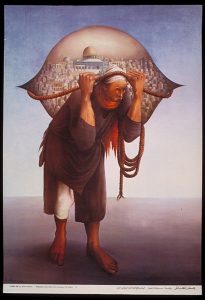
A picture known as ‘Jamal al-Mahamel’ that became an icon which symbolizes the Palestinian struggle, painted by Sulayman Mansur, a renowned Palestinian artist

The world will get crazier because states are not to be founded by ‘announcements’ that distort history and deny people their basic human rights as free citizens. If power makes injustice right in the world of politics, history reveals that, in the world of truth, justice will always prevail, no matter how many decades or centuries it may take. History shows that this same Jerusalem was attacked and occupied by the medieval European crusaders for around two hundred years and eventually gained its freedom at the hands of Saladin who revived the weak, divided Ummah of his time. History shows that the Muslim Ummah could get sick, but it never dies. Many Muslim countries were destroyed by the Mongols in 1258, and in around thirty seven years the grandson of Hulegu became a Muslim named ‘Mahmud Ghazan’ in 1295. History is to be measured by centuries, not just the few years we are witnessing.

The purpose of evoking history here is two-fold. First, I want to emphasize that lasting and real peace, which we all aspire, can never be achieved by unilateral, unjust decision like that of Trump. Second, one of the greatest weapons Muslims, Arabs and free people worldwide have now is to keep having great hope for freedom, to keep denying Trump’s decision as meaningless and unjust and to keep telling the Palestinian story.

Politics aside, al-Quds has always been in the heart of each Muslim and will always remain as such. We pray that God would cleanse all hearts from ignorance, envy, and hatred and that justice would prevail, and peace would spread. Ameen.

[1] Shlomo Sand, The Invention of the Land of Israel, Verso, 2012, p. 260

[2] Henry Cattan, Palestine, The Arabs & Israel, p. 3

[3] Paul Findley, Deliberate Deceptions, p. 4

[4] See The Pilgrimage of Arculfus in the Holy Land, London: [publisher not identified], 1895. pp. 4-5,

[5] Henry Cattan, Palestine, The Arabs & Israel, p. 4

[6] Ibid., p. 7

By Sh. Ahmed Arafat

How to Revive Your Prayer, Part Five


Improve Your Mental Preparation

What is the part that, if missed, will turn your prayer into a series of mumbled words and machine-like movements? Definitely, it is Munajah (intimate conversation with Allah U) that I covered in the first part of this series on reviving our prayers. For this Munajah to be present and effective, a Muslim must be mentally ready for Salah. Just remember the last important interview you had. You must have prepared yourself well by conducting basic interview research: the dress code, direction to the office, learning about the institution on line …etc. Of course, Allah Uis beyond all comparison. So, if you really think of Salah as a great blessing to communicate with Allah U, you should be gratefully prepared.  

            In his al-Fawaid, Imam Ibn al-Qayyim observes: “There are two times when a servant stands before Allah: in Salah and on the Day of Judgment. Whoever takes care of the first standing, the second will be easy for him; whoever neglects the first standing, the second will be hard for him.” Here are quick tips that will help us improve our mental preparation. 

1-      Start with an Undivided Mind.

            Afterpreparing some food for the family members, one of my relatives said “Let us pray first and then eat without any interruptions!” She did not want any Salah thoughts while eating. She wanted to enjoy eating with a clear mind. In response, I said: “Let us eat first and then pray without any interruptions!” To be less distracted during Salah and to strengthen our focus on Salah, the prophet rtaught us to start our prayer with an undivided mind.

            Ibn Umar tnarrated that the prophet rsaid: “When the dinner is being served, and the time for a prayer becomes due, start with the dinner and do not be hasty” (Bukhari & Muslim). That is why, whenever he feels hungry and the food is ready, Ibn Umar tused to start with eating even if he can hear the Imam’s recitation. We should also note that if a person is a little hungry and knows that hunger will not be a distraction, he or she should start with the prayer. ‘Amr ibn Umayyah tnarrated that he saw the prophet using a knife to cut a piece of meat from a cooked sheep shoulder. As the prayer was called, the prophet rput down the meat and the knife and went for offering the prayer” (Bukhari & Muslim).

            Similarly, the prophet rtaught us not to start Salah while we feel that we need to use the bathroom. Instead of praying while you resist the urge to urinate or defecate, you should relieve yourself first. ‘Aiesha said that she heard the prophet rsaying: “No ritual prayer is to be offered when the food is being served or when a person resists “al-akhbathayn” the urge to urinate or defecate.”

2-      Dress Well

Wearing clean and neat clothes indicates that Salah is a special meeting and that you are taking it seriously. This is not a prerequisite for the prayer; however, dressing well is a great mental preparation for Salah. The Quran commands: “O Children of Adam, wear your beautiful apparel at every time and place of prayer: eat and drink: But waste not by excess, for Allah loves not the wasters” (7:31). In accordance with this verse, Tamim al-Dari tbought an expensive garment for Salah

3-      Smell Nice and Subtle

            Smelling well could influence your brain activity. Many scents refresh the mind, create a sense of alertness, boost attentiveness, produce a sense of optimism, fight mental fatigue, improve focus and stimulate clear thinking. It is interesting to note that smelling nice was part of traits of the prophet’s personality. Anas ibn Malik tnarrated: “I have never smelt any musk or amber better than the fragrance of the prophet r” (Reported by Muslim). Umm Salamah also narrated that the prophet rused to wear musk and apply it to the face and hands whenever he performs the wudu. The Sahabah followed this Sunnah very closely. Ibn Mas’ud twas known for his nice smell, and before his prayers he liked two things: “good fragrance and neat clothes.” Similarly, people used to figure out if Ibn Abbas twalked through a street on account of his good smell!

            It is equally important to avoid wearing anything with an overpowering smell since that could be a distraction in Salah. Obviously, one must stay away from anything that produces bad smell. In a clear-cut direction, the prophet rinstructed us: “Let those who ate onions or garlic keep away from our mosque since the angels are harmed by whatever harms humans” (Bukhari & Muslim).

4-      Avoid the Causes of the Hardness of the Heart

Imam Ibn al-Qayyim observed: “Four things, when excessively done, will lead to the hardness of the heart: eating, sleeping, talking and mingling with others.” Have you ever prayed after you overate or overslept? Have you ever prayed after having a long “unnecessary” conversation with somebody? No doubt, this was not the best Salah. Let us discuss the negative effects of overeating, oversleeping and excessive, unnecessary conversations before Salah.

A)    For good focus on Salah, do not eat till you are 100% full. The prophet rsuggested that you may be 66% full! Al-Miqdad ibn Ma’d Yakrib tsaid: I heard the prophet saying: “There is no vessel which the son of Adam can fill that is more evil than his stomach, for it is enough for him to take a few bites in order to straighten his back. Yet if he is overcome by appetite, then he may fill it with a third of food, a third of drink, and a third of breath.”


B)    Besides the medical problems of oversleeping, those who oversleep may feel more tired. This feeling is not a good preparation for Salah.

C)    Try to avoid long conversations before Salah as much as you can. If necessary before Salah, limit your conversations to good causes or important matters. The Quran reads: “In most of their secret talks there is no good except for one who exhorts [others] to a deed of charity or justice or conciliation between people. Whoever does this, seeking the good pleasure of Allah, We shall soon give a reward of the highest (value)” (4:114). Generally speaking, the prophet rtaught us: “Whoever believes in Allah and the Last Day, let him or her say good or be silent.”

5-      Have few moments of contemplation before the first Takbirah.

Some people may start their Salah after a long conversation with others or even laughing or shouting, and suddenly they find themselves praying! Always have at least few moments of silence to prepare your heart and mind. To bring in Khushu’ before you start your prayer, have few seconds to think of one of the following:

A)    Remember a sin you committed and a blessing Allah Ubestowed on you. This will generate a sense of haya’ and humility that makes you look down humbly.

B)    Imagine that this prayer might be the last one for you to offer. In this way, you will try your best to perfect it.

C)    Imagine the glory and greatness of Allah’s creation (e.g. we have more than 150 billion galaxies!) and how small you are. In spite of how small we look, Allah Uhonored us; therefore, feel proud that you are one of His servants.

D)    Think about how short this life is and how eternal the afterlife is. Just 100 years ago, no one alive now was there, and in 100 years, no one who is alive now will be there. This is how short this life is.

6-      Do not start your prayer with a lie!

One of the most effective ways to maintain your focus in Salah is to recognize the meaning of Allahu Akbar through which we start our prayer. Allahu Akbar literally means “God is greater.” Greater than what? Greater than anything you can imagine. Therefore, when you start your prayer with Allahu Akbar, you are basically saying Allah is greater than my money, my school, my work …etc. That is why, Imam al-Ghazali warned: “Make sure that you do not start your prayer with a lie!” It is also interesting to notice that the sentence Allahu Akbar signals most of the movements during the Salah. In other words, “Allah is Greater” serves as a constant reminder that it is shameful to think of anything other than Allah while you are in His presence. In this way, the frequently repeated Allahu Akbar can help us regain our focus if we lost it.

7-      Prepare your Quranic recitations.

Instead of reciting the same exact short Surahs in every prayer, try to memorize a variety of Surahs, short Quranic passages or even single verses. If you can only memorize one verse, here are some suggestions for inspiring verses: (2:186), (2:281), (3:8), (4:135), (16:277), (16:281), (17:23), (24:30), (29:69), (39:53), (41:30), (41:34), (49:10), (49:12), (49:13), and (50:16). 

8      Prepare personal Du’aas.

When you include personal prayers in your Salah for yourself, your family and your Ummah, your Salah will be transformed from being a dead format into a real personal relation. The best part in Salah for personal prayers is during Sujud (prostration). The prophet rtaught us: “Nothing brings the servant closer to Allah more than Sujud; so, offer frequent prayers or supplications” (Reported by Muslim). Practically speaking, prepare your Du’aas and pray earnestly and sincerely.

9-      Allow Enough Time.

When you pray on time, you have a better chance for concentration. Think of the last time you offered a prayer few minutes before the next prayer was due? Think of the last time you had to combine two prayers without a valid excuse? So, for better focus during Salah, allow enough time. Of course, the best option, in this regard, is join the Jama’ah or congregation prayer in the masjid.

10-  Observe the Sunnah Dhikr during the day.

The more you focus on Allah Uoutside Salah, the easier you can focus on Him during Salah. Observing the many Dhikr the prophet taught us throughout the day will help a Muslim develop an undivided heart that is set on Allah Uis willing to surrender to Him completely. Wallahu A’lam

By Sh. Ahmed Arafat

تفسير القرآن العظيم

درس تفسير القران الكريم  للشيخ جمال سعيد

( ساعة قبل العشاء)


 يتناول الدرس كتاب الجامع لأحكام القران للقرطبي و الذي يعتبر موسوعة في تفسير القرآن الكريم، وهو من أفضل كُتب التفسير التي عُنيت بالأحكام، مع الاهتمام ببيان أسباب النزول، وذكر القراءات، واللغات ووجوه الإعراب، وتخريج الأحاديث، وبيان غريب الألفاظ، وتحديد أقوال الفقهاء، وجمع أقاويل السلف ومن تبعهم من الخلف، وقدم المصنف فيه من الاستشهاد بأشعار العرب، وقد نقل عمن سبقه في التفسير، مع تعقيبه على من ينقل عنه، مثل: ابن جرير، وابن عطية، وابن العربي، وإلكيا الهراسي، وأبي بكر الجصاص، وقد أضرب عن كثير من قصص المفسرين، وأخبار المؤرخين، والإسرائيليات، وذكر جانبًا منها أحيانًا، كما رد على الفلاسفة والمعتزلة وغلاة المتصوفة وبقية الفرق، وذكر مذاهب الأئمة وناقشها، ويمتاز هذا التفسير عما سبق من تفاسير أحكام القرآن أنه لم يقتصر على آيات الأحكام فقط، والجانب الفقهي منها، بل ضم إليها كل ما يتعلق بالتفسير

Addressing Our Inner Demon

ADDRESSING OUR INNER DEMON

Allah, the Most High, describes in His Book a type of people promised total and absolute safety on the Day of Judgment. Those promised shelter and subsequent forgiveness of their sins; those whom Ibrahim the Messenger of Allah ﷺ asked to be considered amongst. Allah, the Most High, describes these people in Prophet Ibrahim’s ﷺ supplication as those with a sound heart.

“My Lord, grant me authority and join me with the righteous. And grant me a mention of honor among later generations. And place me among the inheritors of the Garden of bliss. And forgive my father; indeed, he has been of those astray. And do not disgrace me on the Day they (i.e., the people) are resurrected—the Day when neither wealth nor children will be of benefit. But only one who comes to Allah with a sound heart” (Quran 26:83-89).

In these verses, Allah describes the most critical part of the human being to be judged on that day: the heart. As the Messenger of Allah (PBUH) said: “Indeed Allah will not look to your bodies or your images when judging you, but rather to your hearts and actions” (Sahih Muslim). Our hearts and our subsequent actions, as they are an extension and result of what is in our hearts, will be the fulcrum of Allah’s judgment. It is indeed insufficient to claim purity of heart while coupled with foul actions, as our efforts are but a manifestation of what our hearts genuinely value. So much so, that Allah has, in instances, identified human beings with their actions. Allah describes Prophet Noah’s ﷺ son to him saying: “O’ Noah! He is not of your family, indeed he is unrighteous action” (Quran 11:46).

These verses and narrations bring into perspective the close relationship between the values we hold in our hearts and the actions we use to express these values. What the heart accepts and values dictates one’s activity, while one’s actions serve to reinforce the values held by the heart. Hence, we are implored in the Quran and Sunnah to reject any impulse to act out the impurities of our hearts but, more crucially, to purge our hearts. The scholars of Islam have divided the illnesses of the heart into two main categories: 

  • Illnesses rooted in desire and inclination to immorality. 
  • Illnesses rooted in misguidance and misdirection. 

The cure for both types is found in the Quran, as Allah stated that which means: “O’ mankind there has come to you instruction from your Lord and healing for what is in the breasts and guidance and mercy for the believers” (Quran 10:57).

The parable of illness in the heart, which culminates in foul action or foul inaction, is an infection that causes fever. A skilled doctor will address the temperature first as temporary relief and then look for the fever’s cause for permanent relief of both illness and symptoms. However, if one only addresses the fever and allows the infection to thrive, it will result in severe injury or death. Likewise, those who merely spend their lives suppressing disobedience do not address the inner illness of the heart, driving that impulse to disobey. If the disease is allowed to germinate in one’s heart, it may severely diminish the afterlife or even complete deprivation. 

Hence we must continue to work on purifying our hearts with both immediate and long-term treatment. We should suppress the immediate impulse to disobey and then work to address the illness’s root for long-term relief. If the disease is not treated, it will overcome us when we are weak, like an infection that overwhelms the host when the immune system is vulnerable.

This is the meaning of the statement of the Prophet (ﷺ) when he said: “I swear by Allah, The One whom none is rightfully worshipped but He, that an individual may perform the deeds of the people of Paradise till there is but an arm’s length between him and it, when that which has been written will outstrip him so that he performs the deeds of the people of the Hell-Fire and then enters it” (Bukhari and Muslim).  

May Allah teach us of His Book what we are ignorant of and benefit us with what He has taught us.

By Sh. Ali Mashhour

El mejor modelo para los creyentes

El mejor modelo para los creyentes

Queridos hermanos de fe,

Alhamdulilah que puedo compartir una vez mas con ustedes un poco de lo que he aprendido. Cuando confirmamos el testimonio de fe ; creemos en Allah y en Su Mensajero nos damos cuenta cuan importante es el Mensajero de Allah para los creyentes. Es asi como el profeta (saws) es nuestro mejor modelo para seguir. Allah (SWAT) nos dice en el Sagrado Coran,capitulo 68:4; Ciertamente eres de una naturaleza y moral grandiosas. En el capitulo 9:127 Allah(SWAT) dice , Ciertamente se os ha presentado un Mensajero de entre vosotros que se apena por vuestras adversidades, se preocupa y desea que alcanceis el bien[e ingreseis al Paraiso];es compasivo y misericordioso con los creyentes.En el capitulo3:159 Por misericordia de Allah eres compasivo con ellos. Si hubieras sido rudo y duro de corazon se habrian alejado de ti; perdonales, pide perdon por ellos y consultales en las decisiones. Tambien en el capitulo 33:21; Hay un bello ejemplo en el Mensajero de Allah(de valor y firmeza en la fe) para quienes tienen esperanza en Allah, [anhelan ser recompensados] en el Dia del Juicio y recuerdan frecuentemente a Allah.Teniendo en mente todos estos versos que leemos sobre nuestro profeta Mohammad(saws) podemos comprender cuan maravilloso ejemplo  tenemos. Conociendo la vida de nuestro profeta(saws) por medio del Sagrado  Coran y la Sunnah en las hadices, podemos aprender como conducir nuestras vidas de acuerdo como  Allah, El Todopoderoso nos ensena.

Obedeciendo lo que El Creador nos dice y el profeta(saws) podemos tener el Placer Divino. Allah(SWAT) nos dice en el capitulo 47:33 ! Oh, creyentes! Obedeced a Allah y al Mensajero, y no malogreis vuestras obras.Capitulo3:164 Allah ha agraciado a los creyentes enviandoles un Mensajero de entre ellos que les recita Sus preceptos, les purifica y les ensena el Libro y la sabiduria[la Sunnah]. Y por cierto que antes se encontraban en un extravio evidente. En una hadiz Aisha (la paz sea con ella) relata, el caracter de el Mensajero de Allah es como el Coran.(Muslim, Nisai) Esta hadiz asi como tambien todos estos versos nos motivan a tratar de desarrollar un mejor caracter, comportamiento y valores morales que nos ayudaran  a ser mejores siervos de Allah(SWAT).  Como creyente debemos adquirir sabiduria de el Islam para asi acercarnos mas a nuestro Creador. Implementando lo que aprendemos de la Sunnah en nuestro diario vivir seremos capaces de desarrollar estas caracteristicas que ALLAH(SWAT) nos menciona. Que bendicion tan grande tenemos con nosotros que aunque no estuvimos junto al profeta(saws) en ese tiempo, podemos conocerlo por medio de el Coran y las hadices. InshaAllah, que aprovechemos la gran oportunidad de mejorar como creyentes mientras tenemos vida. Amen

Su hermana en Islam,

Celia Snowber

Mi Primer Día en la Mezquita

Asalamalaykum hermanos y hermanas, mi nombre es Jafeth yo soy un Musulmán convertido. Quiero dar gracias por darme la oportunidad para expresar alguna de mis experiencias en el islam. Algo que me impacto cuando yo empecé a ir a la mezquita era que las mujeres se ponían hijabs y que los hombres estaban separados. Yo no pensé nada malo o asumí cosas, mejor pregunte, entonces aprendí que era por respeto. Al principio se me hizo extraño que los hombres estaban separados de las mujeres, ya que había crecido toda mi vida en la iglesia Cristiana conviviendo con ellas. Fue después que empecé a leer el Corán y a aprender de otros hermanos que entendí porque se hace esto. El propósito de esta separación es que ambos los hombres y las mujeres se enfoquen y se sumerjan totalmente a Allah durante la oración, y para que no sean distraídos por ver a personas del sexo opuesto. Esta división entre ambos sexos también ayuda a que los dos mantengan su mente y corazón puros mientras adoran a Dios. Esto me pareció bien porque entonces todos se podían enfocar más en lo que importa, Allah. Lo que se me hizo más difícil fue aprender cómo orar porque era una manera nueva de orar para mí, pero con mucha paciencia aprendí. Sentí que esta manera era mejor porque ensena más respeto a Allah (Alabado y exaltado Es).

            Lo que me impacto al ver a la gente postrándose fue que había tantos tipos de hombres humillándose ante Dios. Se me hizo hermosa la idea de que otras personas en el mundo estuvieran rindiendo oración y alabanzas al mismo tiempo, haciendo el acto de oración aún más íntimo con Dios. Cuando oí la llamada a la oración estaba confundido porque era la primera vez que había oído algo así, y aparte no sabía lo que decían. Fue entonces que un hermano me explico que el llamado era una recitación que se hace antes de orar. Me pareció una idea excelente, ya que así uno sabría cuando tiene que orar. El llamado a la oración también ayuda a que tu mente y cuerpo se relajen y se preparen para orar a Allah, algo que no había experimentado en la iglesia Cristiana. Después de pensar acerca de las cinco oraciones que los musulmanes hacen decidí que era una buena práctica, ya que te ayuda a estar en más contacto con nuestro creador, Allah. Al estar en contacto constante con Allah te ayuda y motiva a ser una mejor persona y Musulmán, ya que uno sabe que se encontrara con Dios pronto y tendrá que dar cuentas de lo que hizo mientras esperaba por la próxima oración. Esto te hace pensar dos veces antes de hacer algo que es considerado un pecado, y te ayuda rectificar tus acciones e intenciones porque siempre estás pensando en la manera que te quieres presentar a el Creador cuando te encuentres de nuevo con El.

Unas de las cosas que me sorprendieron fue que a diferencia de la iglesia, no te presionaban a dar algo que no tenías. Estaba acostumbrado a ver gente dando dinero porque eran presionados a hacerlo, no porque les nacía de corazón. Al ver que en la mezquita no hacían eso me di cuenta que de esa manera la gente donaba dinero  porque les nacía, y lo daban con sinceridad y amor para agradar a Allah, no a ningún ser humano.

Siento como que muchos pasan por las mismas experiencias que yo pase ese día cuando fui a la mezquita por primera vez. A causa de la experiencia que pase aprendí que tenemos que ayudar y guiar a la gente que va a la mezquita por primera vez, ya que ellos no saben lo que está pasando a sus alrededores porque es un idioma y ambiente nuevo. Tenemos que recordar en la manera que nos sentimos esa primera vez que entramos a una mezquita, y guiar a las personas en la manera que nosotros quisiéramos que nos hubieran guiado cuando primero aprendimos del Islam.

Les agradezco por la oportunidad de compartir mis experiencias cuando primero entre al Islam.

Paz y Bendiciones sean con ustedes.

-Jafeth Garcia

Las pruebas de la vida

Queridos hermanos de fe, tenemos que invocar al Todopoderoso, a nuestro Gran Creador que nos ayude a tener paciencia y a poner nuestra confianza en EL(SWAT). Esta vida es temporal pero a la misma vez esta repleta de infinitas pruebas. Algunas son faciles y otras nos llevan casi a la locura, la desesperacion. Es humano sentirse de ese modo y es ahi cuando realmente nos sometemos enteramente y sinceramente a Allah (SWAT).En el Capitulo27:62, Allah(SWAT) dice; Acaso Quien responde al afligido cuando Le invoca, alivia los pesares y hace que vosotros os sucedais unos a otros en la tierra?  Sabemos que la fe, la creencia de El Todopoderoso nos ayudara a calmar nuestras almas de lo que estamos viviendo en ese momento, a desarrollar la paciencia. Debemos de reconocer que estamos en prueba por esa fe que decimos tener.  Allah (SWAT) nos dice en el Sagrado Coran;Capitulo 29:2-3 Acaso piensan los hombres que se les dejara decir: !Creemos! sin ser puestos a prueba? Por cierto que probamos a quienes les precedieron, y Allah bien sabe quienes son los sinceros y quienes los mentirosos. Todo ser humano atenido en una forma u otra; directa o indirectamente pruebas, ejemplos de algunas de las pruebas son las enfermedades,las calmidades,los bienes, los hijos, la familia,y la muerte de alguien querido. En el Capitulo 21:35 Allah(SWAT) dice; Ciertamente toda alma probara la muerte. Os pondremos a prueba a traves de todo lo malo y bueno que os acontezca, y que comparecereis ante Nosotros.

Las pruebas de la vida son en si una ayuda para el creyente pues es asi como el creyente fortalece su fe y se acerca al Creador. Esta suplica es buena de decir si somos sorprendidos por una desgracia,” Qaddara Allahu ma sha-a fa’ala” “Asi lo decreto Allah y El hace lo que desea”. “El creyente fuerte es mejor y mas amado por Allah que el creyente debil, aunque en los dos hay bien.” Esforzaos en lo que os beneficia, buscad ayuda de Allah y no desespereis, si os sucediera una desgracia entonces no digais: si hubiera hecho tal cosa…habria ocurrido” sino decid ,”Qaddara Allahu ma sha-a fa’ala”, porque ciertamente las palabras”si hubiera hecho esto o aquello….”le abren las puertas a Sheitan.” Muslim 4/2052

Tenemos que aprender a depositar esta confianza con Allah, Exaltado Sea, pues asi podremos atener esa paz y tranquilidad espiritual que tanto necesitamos, cuando estas pruebas son puestas en nuestras vidas.El creyente debe saber que Allah,El Misericordioso siempre le dara la fortaleza, la paciencia y la solucion a todas las pruebas y que en Su Sabia Sabiduria siempre el creyente recibira un bien al termino de cada prueba. En una hadiz qudsi  Abu Umamah(raa)narra que El Profeta(saws)dice,”Allah, Glorificado Sea dice,”Oh hijos de Adam, si se mantienen pacientes y con la esperanza de Mi recompensa en la primera calamidad, Yo no estare mas satisfecho con cualquier recompenza exepto El Paraiso.”(Ibn Majah # 60)

Hermanos de fe, no nos demos por vencidos por las pruebas de esta vida pues son temporal como este mundo. Alabado Sea Allah que nos ha dado este bello regalo que es la fe, un instrumento interno con mucho poder cual proviene de El Todopoderoso, Allah!

Su hermana en Islam

Celia Snowber

La confianza en El Creador

La confianza en El Creador

Queridos hermanos de fe, cuantas veces nos hemos encontrado en situaciones dificiles de aguantar y de comprender la sabiduria detras de estas. Es aqui donde nos encontramos vulnerables a los pensamientos negativos que nos llevan a  dudar de como podremos solucionarlos.Un creyente que se encuentra en una situacion asi, debe reconocer que en todo lo que experimenta  en su vida va a ver una solucion pues tiene la confianza en El Creador, “tawakkul”. Confianza y dependencia  envuelve creer , depender y actuar pues sabe que todo esta bajo La Autoridad Divida,Allah(SWAT) , El Supremo en grandeza, Elque esta a cargo de todo. Nada ocurre excepto con Su Permiso y al someternos  es una forma de adoracion y es parte de completar y perfeccionar nuestra fe. Es la realisacion de el verso de la Apertura de el Coran capitulo1, verso5; Solo a Ti adoramos y solo a Ti imploramos ayuda. Allah(SWAT) dice en el sagrado Coran, Capitulo3, verso159:Pero cuando hayas tomado una decision encomiendate a Allah. Allah ama a quienes se encomiendan a El. Tenemos que confiar en El(SWAT) pues tener fe es creer que no estaremos solos en cualquier dificultad que enfrentemos. En una hadiz [At-Tirmidhi]relatada por El profeta (saws) que dijo,” Si ustedes confiaran en Allah(SWAT) como se debe El les proveeria asi como El provee a los pajaros,cuales se levantan en la manana hambrientos y regresan con sus estomagos llenos al anochecer. En el capitulo 65,verso3, Allah(SWAT) dice;  Y le sustentara de donde menos espera. Y quien se encomiende a Allah, sepa que El le sera suficiente y que Allah siempre hace que se ejecuten Sus ordenes. Ciertamente El ha establecido a cada cosa su justa medida.

En una autentica hadiz de Bukhari y Muslim, Ibn Abbas (raa)reporta de el mensajero de Allah(saws) usaba suplicar :” O Allah a Ti me he sometido, en Ti yo creo, en Ti pongo mi confianza,hacia Ti regreso, por Ti me sostengo.Oh Allah, Yo busco refugio contigo por Tu Poder; no hay nada digno de adoracion exepto solo Tu; que me has  protejido de extraviarme.Tu eres El Vivo,El Sustentador y Protector de todo lo que existe; el Que nunca muere, mientras que los seres humanos y genios morimos.” Esta suplica nos ensena como el profeta Mohammad(saws) se sometia, su fe, su confianza y nos demuestra cuan necesario es confiar y depender de nuestro Creador en todos nuestros asuntos.

Finalmente,aquel quien ponga su confianza sincera en Allah(SWAT) no estara deprimido por lo que ha perdido, o intoxicado por su triunfo pero tendra una paz, una tranquilidad interna pues Allah(SWAT) dice en el capitulo 57 , verso22-23 ,” No sucede ninguna desgracia en la Tierra no os azota a vosotros mismos adversidad alguna sin que este registrada en un libro[la Tabla Protegida] antes de que acaezca.Ello es facil para Allah.” “No os desespereis por lo que no habeis conseguido y no os regocijeis por lo que se os ha concedido. Ciertamente Allah no ama a los arrogantes, jactanciosos.” Empezemos a poner nuestra confianza en el Creador en todos nuestros asuntos pues creemos en El, Alabado Sea!

Su hermana de fe

Celia Snowber

El Bendito Mes de Ramadan

Queridos hermanos de fe, Feliz Ramadan! Alhamdulilah el mes de Ramadan ya esta aqui dandonos una nueva oportunidad para alcanzar una cercania espiritual con nuestro Creador, Allah(SWAT).Este mes debe ser inigualable pues todo lo que hemos hecho anteriormente debe ser una preparacion para asi en este mes enfocarnos y ganar inshaAllah toda una recompenza que solo El Todopoderoso conoze.

Una de las cosas recomendables antes de comenzar a ayunar es tener la intencion de ayunar.El Profeta(saws) dijo:” Aquel que no hace su intencion antes de la madrugada(FAJR), no hay ayuno para el.” {Abu-Dawood, Al-Tirmidhi, Al-Nassai}  Otra accion muy beneficiosa es hacer uso de este mes para leer el Sagrado Coran, la palabra de nuestro Creador. En el Sagrado Coran  capitulo 2, verso 185 dice; En el mes de Ramadan fue revelado el Coran como guia para la humanidad y evidencia de la guia y el criterio.Si nos trasamos la meta de comenzar a leer podremos terminarlo en Ramadan.Tenemos que acordarnos que toda accion buena hecha en este mes sera multiplicada mucho mas que en los otros meses de el ano.  En este mes es bueno hacer mas  caridad. Cuando hacemos caridad nos ensena a ser mas generosos. En una hadiz, Ibn Abbas (raa) reporta que el Profeta (saws) era el mas generoso de la gente y mas generoso aun durante el mes de Ramadan cuando el angel Gabriel(as) lo visitaba. El angel Gabriel (as)se encontraba con el (saws)cada noche de Ramadan hasta el final de el mes y el Profeta (saws)le recitaba el Coran a el angel Gabriel(as). Cuando el angel Gabriel (as) se encontraba con el (saws), el era mas generoso que un viento rapido trayendo la lluvia.[BUKHARI.MUSLIM]En las noches de Ramadan se nos da la oportunidad de los resos voluntarios como las tarawias.Y en nuestros hogares en las noches de Ramadan,antes de la merienda (suhur) podemos hacer los resos(qiyam) cual nos ayuda a connectarnos y a sentir una cercania con Allah(SWAT).  Es importante de buscar  el perdon Divino y  de los seres humanos que hemos lastimado para asi empezar el mes sin rencores y limpios en el corazon. En una hadiz Musnad Ahmad,Sunan Ibn Majah y At-Tirmidhi relata Umm al Muminin, la madre de los creyentes Aisha (raa) que fue preguntada que era lo que el Profeta Mohammad (saws) suplicaba durante los ultimos 10 dias de Ramadan. Ella(raa) contesto: ” Allahumma innaka Afuwwun TuHibbul Afwa Fa fu Anni” ,”Oh Allah, Tu eres El Perdonador, Tu amas perdonar, perdoname.”

 Siempre tendremos oportunidades para mejorar como siervos de Allah (SWAT)sea adorandolo, alabandolo, agradeciendole, pidiendo perdon, dando caridad, compartiendo y ayudando a otros, hagamoslo mientras tengamos la bendicion de estar vivos. Seamos inteligentes y usemos este mes sagrado para multiplicar nuestras acciones buenas y acercarnos espiritualmente a nuestro Creador. Que Allah (SAWT) nos de la dicha de poder ayunar este mes de Ramadan y lo acepte y nos recompense. Amen!

Su hermana de fe,

Celia Snowber

MI CONVERSIÓNAL ISLAM 2

Magdalena Hanafi

Mi Conversiónal Islam

En el Nombre de Allah el Compasivo el Misericordioso

Assalamu Alaykum.

Mi nombre es Magdalena, soy originaria de la Ciudad de Méxicoy provengo de una familia donde todos en un momento dado éramos Católicos aunque no practicantes como se suele decir -solo de nombre- algunos lo siguen siendo y otros optamos por seguir otras religiones.

Yo siempre estuve consciente de la existencia de Dios Todo Poderoso, pero la manera de Adoración con la que crecí no me satisfacía; sentía un enorme vacío en mi corazón. Sentía que había una manera mucho mejor para adorar a Dios, pero la verdad no sabíacual era.

Trate otras religiones entre ellas la de los testigos de Jehova, teníauna amiga que seguía esa religión y siempre me hablaba de la Biblia, un día ella me invitó a su congregación y fui…pero seguía ese vacío.

Fue hasta que conocí a mi esposo quien es Egipcio y con el cual he estado casada por 35 añosque supe acerca del Islam, Alhamdu li Allah!!!aunqueno fue inmediata mi conversión pues pasaron 15 años para que yo aceptara el Islam.Durante ese tiempome sorprendía mucho la manera en como mi esposo adoraba a Allah subhana wa ta’ala, especialmente el ritual del rezo y cuando ayunaba durante el mes de Ramadan.

Cuando yo le hacia alguna pregunta sobre el Islam a mi esposo, elsiempre me dabauna respuesta, a la cual yo le encontraba lógica.Fue entonces que empecé a suplicarle a Allah subhana wa ta’ala, le pedia : “Si el Islam es la verdadera religión, por favor Allah guíame, hazme sentirla en mi corazón y si es esta la religiónque debo seguir, dame discernimiento y sabiduría para entenderla”.También influyó en mi mucho la manera respetuosa de como mi esposo nos trataba a mi y a nuestros hijos; a mi familia y especialmente a mis padres, y su disposición de ayudarlos en el momento necesario; ¡ y como el expresaba su gran amor por sus padres y hermanas! Todo eso me hacía ver que algo muy bueno tenía esta religión.

Lo que más me atraía del Islam era la adoración pura a un Solo Dios; tenía mucha importanciapara mí eso.Así fue como poco a poco fui leyendo, estudiando y aprendiendo sobre nuestro Creador y nuestro querido Profeta Muhammed (saw) y cada vez me gustaba más aprender acerca del Islam.

Más adelante conocí a la hermana Celia, Alhamdu le Allah por ponerla en mi camino!Ella me invitó a unas reuniones que hacía con miembros de su familia donde se presentaban diferentes temas sobre el Islam,Ma sha Allah y Alhamdu li Allah fue entonces que yo estuve convencida de ser una musulmana e hice mi shahada! Aprendí y continúo aprendiendo mucho de la hermana Celia que Allah subhana wata’ala la recompense con lo mejor de esta vida y la otra a ella, a su familia y toda su descendencia.Amen.

Allah subhana wa ta’ala ha sido tan Generoso y Misericordioso conmigo ya que me encaminó al Islam, y ha puesto gente muy buena en mi camino.

Me sentía tan contenta con mi nueva práctica de adoración y estaba tan emocionada que quería transmitir todo lo que estaba aprendiendo y empecé a compartir de acuerdo a mis conocimientos lo que era el Islam con mis hermanos; fue muy difícil, algunos de mis hermanos si me escucharon y parecía que les gustaba,pero hubo otros queno aceptaban que les hablara sobre el Islam, me criticaron y se burlaron de mí, y aún máscuando empecé a usar mi velo, pero no me importaba porque al fin yo me sentía completamente feliz en mi manera de adorar a Allah subhana wa ta’ala.

Fue tan bonito cuando les hablé del Islam a mis padres.Mi padre fue el primero en aceptarlo tenía 86 años. Luego al poco tiempo mi madre a los 78 añostambién lo aceptó, Alhamdu li Allah. Qué bendecidos hemos sido por mi Creador!Mi padre murió siendo musulman hace un año a los 97 años(que Allah le de el Paríaso), tenía bien claro el concepto de la adoración pura a un sólo Dios y creía en el Profeta Muhammed (saw) como mensajero y siervo de Allah, sus últimas palabras verbales fueron “Alhmadu li Allah” de ahí ya no volvió a emitir ninguna palabra pero Alhamdu li Allah levantaba su dedo índice indicando la Unicidad de Allah, era una costumbre que teníamos el y yo cuando nos veíamos. A mi madre se le dificultó mucho más, porque algunos de mis hermanos no aceptaban que ella siguiera el Islam decían queera una religión sólo para los árabes, trataron de convencerlapara que se alejara y que cambiara su decisiónpero ella se mantuvo bien firme, y les decía:“yo voy a seguir en esta religión y de aquí no me salgo”.Lo que me sorprende de mi madre es que tiene más de cuarenta años viviendo en los Estados Unidos y en todo ese tiempo, el inglés no se le ha dado y no puede decir una oración en Inglés, pero Alhamdu li Allah se memorizó la Fatiha en árabe.

Por ahí hay algunos de mis hermanos que les gusta el Islam, hago muchas súplicas todos los días para que Allah los guíe hacia esta hermosa religión.

Doy gracias a Allah subhana wa ta’alapor guiarme por el camino del Islam después de mucho tiempo que estuve extraviada y confundida, y le suplico que nunca me saque de Su Guía. También le pido a Allah que Guíe y mantenga bien firme a mis hijos, sus familias, a toda mi descendencia y a toda la ummah por la via recta y que nos de todo lo mejor en esta vida y la otra…

Amen.

Su hermana en islam,

Magdalena Hanafi