Mosque Foundation | Bridgeview, Illinois Logo
Mosque Foundation | Bridgeview, Illinois

Mosque Foundation

YOUTUBE CHANNEL

First Friday Prayer is at 12:30pm. Second Friday Prayer is at 2:00pm.

YOUTUBE CHANNEL

Maintaining the Momentum

Ramadan has bid us farewell yet again. May Allah ﷻ accept our fasting, prayers, and charitable acts. This sacred month has allowed us to practice mindfulness and spiritual nourishment as we untangle the many thoughts, emotions, and habits we have been distracted from attending. This month-long journey results in developing taqwa, which is an elevated bond humans possess with their Creator ﷻ. 

As Allah ﷻ states, “O you who have believed, decreed upon you is fasting as it was decreed upon those before you that you may become God-conscious” (Quran 2:183).

This state of mind colors our thoughts, emotions, and actions following the completion of Ramadan. Every thought that enters our mind becomes subject to a process of filtering based on the love of pleasing Allah ﷻ and the fear of displeasing Him. We evaluate each feeling that enters our hearts and our actions.

How do we carry these models we established over a month for the remainder of the year? Here I discuss some ways to maintain the benefits of Ramadan throughout the year.

  1. Pray 5 Times a Day, Every Day: There is no doubt that obligatory prayers are an essential form of worship a Muslim engages in daily. The Messenger of Allah ﷺ was reported to have said, “The first matter that the enslaved person will be brought to account for on the Day of Judgment is the prayer. If it is sound, then the rest of his deeds will be sound. And if it is bad, then the rest of his deeds will be bad” (Sahih al-Jami). Each prayer serves as a mechanism of purification, expiating the sins which occurred before it as Allah ﷻ states, Recite, [O Muhammad], what has been revealed to you of the Book and establish prayer. Indeed, prayer prohibits immorality and wrongdoing, and the remembrance of Allah is greater. And Allah knows that which you do” (Quran 29:45). It is essential to focus your efforts and energy on safeguarding this pillar of Islam throughout the year above all other matters. Everything else will follow bi’thinillah.
  2. Make Fasting a Habit: Much research is now pointing to the health benefits of fasting two days a week, as was the customary practice of our beloved Prophet Muhammad ﷺ each Monday and Thursday over 1400 years ago. In addition to physical health, fasting nafila promotes spiritual health. Think of each time you stopped stating something, looking at something, or doing something displeasing to Allah ﷻ during Ramadan because you were fasting. By a similar token, think of all the instances you felt encouraged to remember and be thankful to Allah, to gaze upon His Holy Book, and to do charitable acts because you were fasting. A great way to maintain this mindfulness is to make fasting a habit since it combines patience in obeying Allah and refraining from what He has prohibited. Also, fasting is a means of gaining an immense reward. The Messenger of Allah ﷺ was reported to have said, Every deed of the son of Adam will be multiplied between ten and seven hundred times. Allah, may He be glorified and exalted, said: Except fasting. It is for Me, and I shall reward for it. He gives up his desires and food for My sake” (Muslim).
  3. Give…from Everything: If we fasted during the month of Ramadan sincerely, we should have developed a sense of gratitude, which is a great motivator to give. Giving Zakat is an obligatory pillar of Islam and is mentioned in the Quran almost every time obligatory prayers are mentioned. The practice of providing sadaqa is also encouraged and rewarded immensely. In addition to giving from our wealth, Ramadan teaches us to share our time and attention to what matters most. We refrain from immersing ourselves in conversations or on social media focused solely on what so and so ate today or wore today. Instead, Ramadan teaches us to connect with those whom Allah ﷻ will hold us accountable for on the Day of Judgment, such as our families. Allah ﷻ states, “And do not extend your eyes toward that by which We have given enjoyment to [some] categories of them, [its being but] the splendor of worldly life by which We test them. And the provision of your Lord is better and more enduring. And enjoin prayer upon your family [and people] and be steadfast therein. We ask you not for provision; We provide for you, and the [best] outcome is for [those of] righteousness.” (Quran 20:131-132). Volunteering at a local Masjid or a humanitarian organization is a great way to maintain our gratitude.
  4. Befriend the Quran: The relationship between Ramadan and the Quran is exemplified repeatedly within the Quran itself and the Sunnah of the Prophet Muhammad ﷺ. As Allah ﷻ states, “The month of Ramadan in which was revealed the Qur’an, a guidance for the people and clear proofs of guidance and criterion” (2:185). The number of classes offered to a diverse range of learners specialized in Quran recitation, memorization, and Tafseer does not allow anyone to have an excuse not to have the Quran be a part of their daily living. There are no excuses for a person not to become a life-long student of the Quran in this age of accessibility. Make listening to the Quran a habit every morning on your way to school or work, as you would make it a habit to listen to other things. Enroll in a Quran class to learn how to recite or advance in your recitation. Attend a weekly halaqa to gain new understanding and wisdom of this miracle Allah ﷻ has bestowed upon the Ummah of Muhammad ﷺ.
  5. Make Dua’a: During Ramadan, we also become accustomed to making du’a’ and speaking to Allah ﷻ, especially during nightly prayers. This is a highly recommended form of worship to maintain throughout the year and serves as an act of humility and submission to our Creator ﷻ. Allah ﷻ states, “And your Lord says, “Call upon Me; I will respond to you.” Indeed, those who disdain My worship will enter Hell [rendered] contemptible” (40:60). What greater promise can we receive from Allah ﷻ than the one illustrated in this verse? Learning and reciting the different supplications detailed in the Quran and Sunnah daily is a great habit, such as supplications upon waking, before sleeping, before eating, etc.

I pray that we can use these tools that Allah ﷻ has equipped us with during the month of Ramadan to maintain our spiritual momentum and productivity throughout the year.

By Sh. Jamal Said

Keep Calm and Fear Allah

Allah, the Most High, explains in His book everything which humans need to understand on their path to salvation. Of the most crucial things, He has revealed why things do or do not happen in this world. Of these actions of Allah are various crises and tribulations which He afflicts with whom He chooses.

He explains:  

{And we send not the signs except as a warning} [Quran 17:59]. {And we have already sent [messengers] to nations before you, [O Muhammad];  These messengers sent to each nation are sent to recalibrate their moral compass and define for them right and wrong, good and evil, and inform them of the consequences of each. But if the people ignore what the messengers inform them of or deny the messenger’s validity after the truth has been totally clarified to them out of arrogance or pride Allah afflicts them with crises that will break through this arrogance and pride that the truth may reach their hearts and bring out the good in them if there is any good therein. {Then we seized them with poverty and hardship} the affliction is in their wealth and health, their society at large and in their individual personal lives {that perhaps they might humble themselves [to us]}. 

So we are told that these afflictions, whereas a kind of wakeup call for the masses, that they may be humbled and turn to Allah in hope and fear, that people might be shaken out of their slumber and reflect on their mortality and responsibilities toward their Lord and others.  {Then why, when Our punishment came to them, did they not humble themselves?} This is the antidote to the chaos. We surmise from this that humility to Allah by way of earnest repentance and observance of His commands will alleviate these crises.  {Instead, their hearts became hardened} with sin, {and Satan made attractive to them that which they were doing} of disobedience and transgression of the laws of Allah. Being that no matter their state of being, they were dedicated to disbelief and sin and transgression, their affliction, which was really a blessing an opportunity in disguise which now became their undoing.

{So when they forgot that by which they had been reminded} What’s meant by ‘forgot’ here is that they treated the commands of Allah with total disregard as if they had totally forgotten that a messenger was even sent to them.  {We opened upon them the doors of every [good] thing} which they desire of the life of this world of wealth and health and technology and various comforts.  {Until, when they rejoiced in that which they were given} Becoming proud and deluded believing that what they were given of luxury was an indication they were beloved to Allah and endowed.  {We seized them suddenly, and they were [then] in despair}  [Quran 6:42-44].

For this reason, we see that our Prophet ﷺ who has the least to fear with regards to punishment, would react with instant humility and fear and reverence of Allah whenever he would observe anything that could be understood as a prelude to the punishment of Allah.  

{And mention, [O Muhammad], the brother of ‘Aad, when he warned his people in the [region of] al-Ahqaf – and warners had already passed on before him and after him – [saying], “Do not worship except Allah. Indeed, I fear for you the punishment of a terrible day.” They said, “Have you come to delude us away from our gods? Then bring us what you promise us if you should be of the truthful.”

He said, “Knowledge [of its time] is only with Allah, and I convey to you that with which I was sent, but I see you [to be] a people behaving ignorantly.”

And when they saw it as a cloud approaching their valleys, they said, “This is a cloud bringing us rain!” Rather, it is that for which you were impatient: a wind, within it a painful punishment,

Destroying everything by the command of its Lord. And they became so that nothing was seen [of them] except their dwellings. Thus do we recompense the criminal people?

And we had certainly established them in such as we have not established you, and we made for them hearing and vision and hearts. But their hearing and vision and hearts availed them not from anything [of the punishment] when they were [continually] rejecting the signs of Allah, and they were enveloped by what they used to ridicule} [Quran 46:21-26].

Narrated Aisha (the wife of the Prophet): “Whenever he (the messenger) saw clouds or winds, signs of deep concern would appear on his face. I said, O Allah’s Messenger! When people see clouds they usually feel happy, hoping that it would rain, yet when you see clouds, I notice signs of concern on your face. He said:  ((O `Aisha! What is the guarantee for me that there will be no punishment in it since some people were punished with a wind? Verily, some people saw (received) the punishment, but (while seeing the cloud) they said, ‘This cloud will give us rain’)) [Bukhari: 4828].

It is surely troubling to see people, many of which are Muslim, making a mockery of the world’s current state, with memes and satirical songs and various social media posts, etc. If worldwide illness, war, famine, occupation, and economic collapse on a scale rarely if ever observed in human history does not humble us to Allah, then I ask… what will? The Hajj and Umrah are suspended, for only the fourth time in the history of Islam, we observe the Kabah empty with no one circumambulating, standing, bowing, and prostrating in its arena. The world is at the brink of war at the drop of a hat; children are dying of starvation in the capitals of Syria and Yemen. The Palestinian conflict has gotten its worst, with detailed plans of completely severing the West Bank from its capital of Jerusalem and making it totally inaccessible without a passport to its neighboring villages. 

Countless lives have been lost in Burma and India with the mass armed public lynching of Muslims for being suspected of possessing beef. In the communist state of China, millions of Muslim men women and children have been shipped off to concentration camps dubbed “re-education centers” scattered throughout the country. Muslim children have been forcefully taken from their parents and entered into such camps to be stripped of their identities and made to march around in formation singing the praises of the communist state and stripped of even their language, let alone their religion and cultural identity. Suicide rates are at an all-time high, especially amongst the young. Drug use, fornication, and sexual perversion and depravity have become commonplace. If this does not stir us as Muslims and human beings from our slumber, I ask, what will? 

By Sh. Ali Mashhour

Programs and events

Community Alert

 To help protect our community and prevent the further spread of COVID-19, the Mosque Foundation is canceling and postponing events until further notice from health officials.

The Mosque Foundation is taking the precautionary measure to suspend all extracurricular Masjid, MFEC, MFCC, Al-Siddiq Sunday School, and Harlem Center activities including classes, halaqas, Quran programs, men’s programs, women’s program’s, youth programs, weekend school, afterschool programs, fitness classes, General Assembly Meeting, etc., until further notice from health officials.

This measure is to help protect our community and curb the spread of COVID-19.

Daily and Jumu’ah prayers remain scheduled to be held at the Masjid but in a shortened time frame. Full-time staff will also be available at our facilities to serve the community.

The Mosque Foundation will post updates on our website and through email as the situation evolves. In the meantime, we highly advise you to take these precautionary measures:

  • Frequently wash hands with soap
  • Clean and sanitize high-touch surfaces daily
  • Avoid contact with those who are sick
  • If you are sick, stay home
  • Cover your coughs and sneezes
  • Avoid touching your eyes, nose, and mouth

For more information about COVID-19, visit the website for the Centers for Disease Control and Prevention, cdc.gov/Coronavirus/2019-nCOV.

Listen to this message from Clinical Immunologist, Dr. Waseem Imam, as he answers common questions about COVID 19.

coronavirus (2019-nCoV)

The novel coronavirus (2019-nCoV) continues to spread, and the headlines this week point toward a likely rise in cases in the western hemisphere. Dozens of countries continue to report new cases. Two deaths occurred in the US so far. The number of patients may increase if the pattern in other countries is repeated.

As a pulmonologist and critical care specialist who deals with the sickest of patients with respiratory failure related to infections like COVID19, I  advise everyone to take this pandemic seriously and follow the recommendations of public health officials. 

Here are simple steps that everyone can take, which are based on public health principles and religious practices:

  1. If you are or have been exposed to someone, who suffers from a contagious illness, like the flu, common cold, or the new coronavirus (COVID19), you have the responsibility of preventing harm to others by staying home to prevent the illness from spreading to others.
  2. Consult with your doctor if you have a fever, cough, shortness of breath, and fatigue.
  3. Limit unnecessary international travel and avoid travel to China, South Korea, Japan, and Italy. 
  4. Wash your hands frequently and thoroughly for at least 20 seconds. Be sure to wash in between your fingers, under nails, and including the wrist with soap and water. Use sanitizer frequently, especially after touching others or shaking hands. 
  5. Wash your nose and mouth often. For Muslims, it is similar to what we do in preparation for prayer during Ablution (Wudu).
  6. Avoid shaking hands or hugging people unnecessarily. 
  7. Avoid coming to gatherings, prayer services in congregations or other meetings if you are sick or exposed to someone who is sick 
  8. When you sneeze, cover your mouth and nose with a napkin or sneeze into your arm at the elbow.
  9. Use masks only if you are sick or exposed to someone who is sick. There is no need to use a mask if you are not sick or a healthcare provider. No need to buy N95 masks. It is not recommended to the general public, and it won’t provide you with adequate protection. You are hurting healthcare workers who may need them by creating a shortage in the market. 
  10. Get your influenza vaccine if you haven’t already done so. This will reduce the amount of viral respiratory cases in the community.
  11. Avoid touching your eyes, nose, and mouth with unwashed hands.
  12. Avoid close contact with people who are sick.
  13. Clean and disinfect frequently touched surfaces and objects.
  14. Check the CDC website for the most accurate and up to date information, and feel free to contact the infection prevention hotline if you have any questions.
  15. And no, this is not a conspiracy or hoax. We have the best healthcare system in the world, but we need to do our part.

Zaher Sahloul, MD

In Solidarity with Black Lives

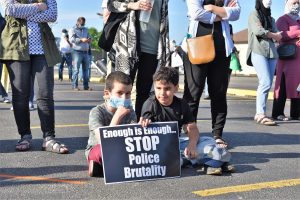
06/06/2020 – Bridgeview, IL – The Mosque Foundation stands in solidarity with our Black brothers and sisters in America and across the globe. In response to the widespread violence and systemic racism experienced by the Black community at the hands of law enforcement, the Mosque Foundation hosted a rally on June 6, 2020. The rally was well attended by local community members, the majority of whom were youth and families; brought together in cooperation with the Muslim American Society (MAS) of Chicago and American Muslims for Palestine (AMP). Tarek Khalil, AMP Chicago board member, moderated the event and introduced our guest speakers.

President of the Mosque Foundation, Br. Oussama Jammal, welcomed and thanked the community for showing up to express their true feelings for a just cause. “Without [Black people] we could not have built America today,” said Br. Oussama, “It is their blood, their sweat, and tears that built this country, and they should be treated more than equally.”
In Solidarity with Black Lives

Click here to see more photos

Representing the Council of Islamic Organizations of Greater Chicago, the Executive Director, Br. Abdullah Mitchell, also spoke, saying, “I’m tired, I can’t breathe …there’s injustice even in access to food…healthcare disparities that infect the Black communities…a criminal justice system that continues to victimize Black people.”

Longtime community member, Sr. Donna Demir, also addressed the attendees regarding being one of the few Black members of the Mosque Foundation community. “I am not from Ramallah or Beitunia,” Sr. Donna said, “I’m here because of my love and because of the grace of Allah ﷻ.” Sr. Donna challenged the community by exposing truths of the hardships of being a Black person in America. The starting point to heal: pay attention, listen, learn, and grow. 

Next, Sr. Iman Williams spoke from her perspective as a Black and Palestinian youth living in America. She urged the community to create a welcoming atmosphere for all regardless of our differing ethnicities. “The youth of my generation need to be a part of the positive change to our community…We need action. Followup. Because if we do not actively combat racism, we will be here again next week, next month, talking about the next Black man, woman, or child.”

Sr. Deanna Othman is an active member of the community; she’s an educator, a mother, and an author. She tells the audience that we are at a turning point in rebelling against systemic racism. “Now is the time to realize that this land you came to as a refuge from colonialism or occupation or dictatorship has never been a place of refuge for another community.” Indeed, it’s time to wake up and confront difficult questions. 

Imam Warith Deen Muhammad II also took the stage. He was pleased to see the crowd coming out to support Black lives and expressed his appreciation for all the supporters. Imam Warith spoke about historical slavery and abuse of Black people but reiterated his hope for a brighter future. “It’s my strong belief that we are not in a hopeless position right now,” he said. “The corruption is always temporary.” 

MFCC Youth leader, Br. Jameel Karim, took the stage with many powerful statements, most notably imploring all to “Check yourselves…check each other… end of discussion.” Indeed, it is of utmost importance for everyone to work on purifying their hearts. “We are Muslims. We represent the greatest man that ever walked on this planet. The greatest gift we can give Black people is, Islam,” said Br. Jameel, “It is what gives us true justice. It’s a gift from Allah. A true believer can never be racist.”

Dr. Raed F. Abusuwwa, President of MAS, reminded the audience that Islam came to reeducate society. “It doesn’t matter your race, ethnicity, or gender. What matters is what you live for, what you stand for in history, and your actions.” 

Finally, Sh. Jamal Said concluded the event by thanking the attendees and speakers. Sh. Jamal used his time on stage to remind the audience that “Silence is violence…with no justice, there is no peace.” He acknowledges that we have a lot to learn as a community to end this business as usual attitude. In the end, with a commanding gesture, Sh. Jamal asked everyone to raise their right hand and make a pledge never to use the derogatory term ‘abeed’ again. 

We must take up the cause to let the world know that Black lives matter whether it’s in the Southside of Chicago or across the globe. We must respect life, and it must start now. The challenge is on us as Muslims to stand for justice for all.


Scholarships

Mosque Foundation Educational Center presents ” Scholarship Program” .

Click the Image for scholarship application

 

The Blessed Journey of Your Generosity

There are many windows of opportunities in this life uniquely placed by Allah ﷻ, to purify our souls and gain forgiveness for our sins. These opportunities are open to every single believing individual, young or old, poor or wealthy, ill or healthy, educated or illiterate; it matters not. Some take advantage of windows, seeking them with every twist and turn in this worldly life, both in happiness and calamity. For these people called al-Mossaddiqeen, Allah has created a special manzilah or level in the heavens for those who give Sadaqah consistently. It is the quality for which they are most recognized and will be witnessed on the day when nothing can attest to them but their deeds.

This group of people finds the best bargains and offers, continually searching for the best deal. The deal granted by He who created us and assigned us provisions. Allah ﷻ says, “Who will loan Allah a lofty loan which Allah will double unto their credit and multiply many times?” (2:245). The Mossaddiqeen grasped this deal because they recognized it is like no other that can be granted in this worldly life. My brothers and sisters, Allah grants us provisions, and He asks that we give from what He has blessed us so that He may provide us with more; how generous is Our Creator ﷻ.

So, even when it is challenging to give Sadaqah, the Mossaddiqeen remember that it does not decrease their wealth. The Prophet ﷺ was reported to have stated, “Charity does not decrease wealth, and those who forgive, Allah makes them more respected; and the ones who show humility, Allah elevates them in the eyes of the people” (Muslim).

For this reason, the Mosque Foundation community’s perception of Sadaqah has gained high regard and esteem from other communities. Your sincere commitment to the House of Allah places great baraka (blessings) in your wealth and possessions and protects your families, and will continue to do so, bi’thinillah. To spend in Allah’s cause by propagating His religion is a charity with high merit and great reward. Those who spend in the cause of Allah will continue to be rewarded even after their death. They are providing a place to pray, to learn about their religion, and to seek counsel. What is spent on the house of Allah will be rewarded with a home in heaven, as Prophet Muhammad ﷺ was reported to have stated, “Whoever builds a Masjid for Allah, Allah will build for them a similar house in Paradise” (Bukhari).

To ensure that our Sadaqat are accepted, we must consider several requirements. First of all, Sadaqah must be given from money that is earned lawfully. Allah ﷻ says, “O you who believe, spend from what you (lawfully) earned,” (2: 267). Second, when giving Sadaqah, the believers must purify their intention and make their purpose for the sake of gaining Allah’s pleasure and reward. The Prophet ﷺ said, “All deeds are based on intention, and everyone will be rewarded according to what he intended” (Bukhari).

Third, the believer should make haste in giving Sadaqah and not delay it without a valid reason. It is also better for Muslims to give Sadaqah when they need to wait until death. Prophet Muhammad ﷺ was once asked about the best of all charities to which he replied, “The best charity is what you give during your life while you need it.”

Fourth, it is more befitting for Muslims to give Sadaqah from their best possessions, which they love most. Allah ﷻ says, “By no means shall you attain righteousness unless you give (freely as a charity) from that which you love, and whatever you spend Allah knows it well” (3:92). However, this does not mean that we should lessen the value of our Sadaqah if we have little to give. Prophet Muhammad ﷺ once said to his companions, “One Dirham could be better in reward than one hundred thousand Dirhams.” A man asked, “And how is that O Messenger of Allah?” He ﷺ replied, “A wealthy man takes one hundred thousand Dirhams, which is one part of his wealth and gives it as a charity, while a poor man who only has two Dirhams pays one of them as a charity.”

By Sh. Jamal Said

Hajj Workshop

IG IFTAR NIGHT

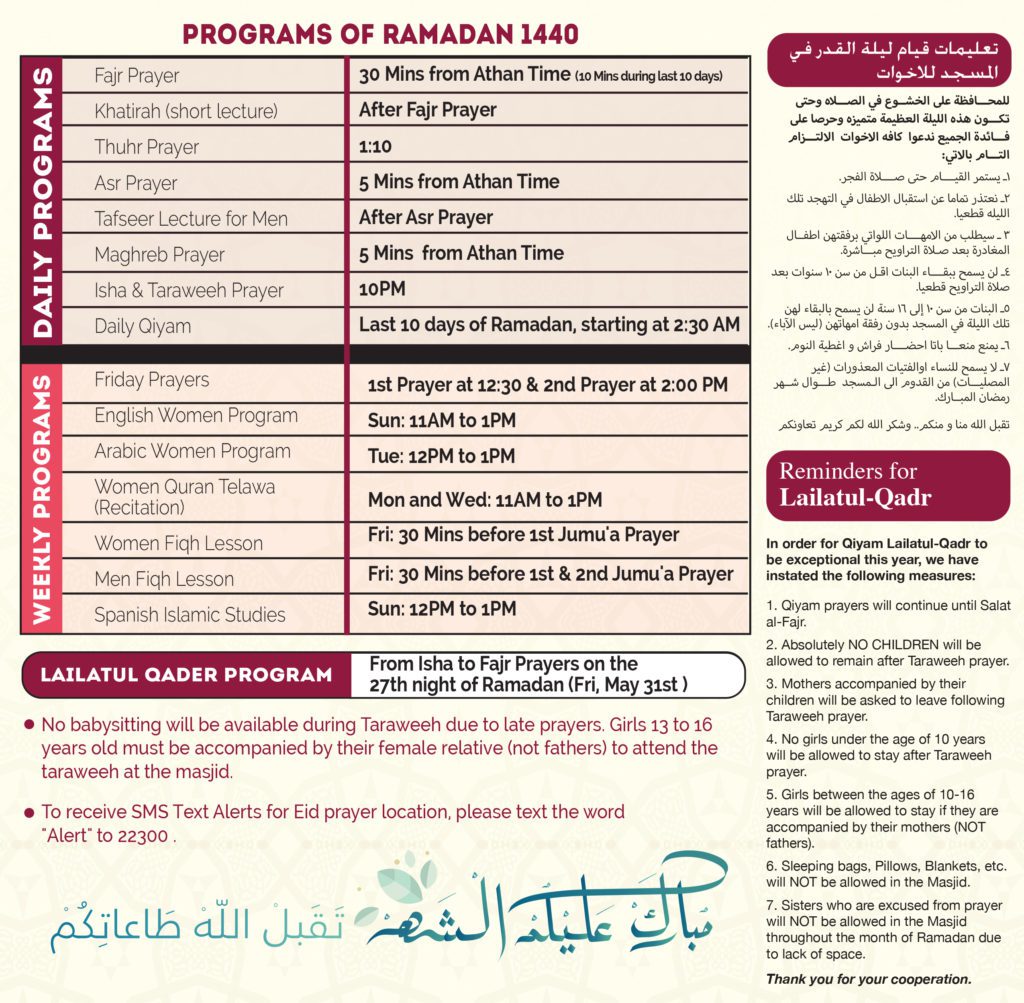
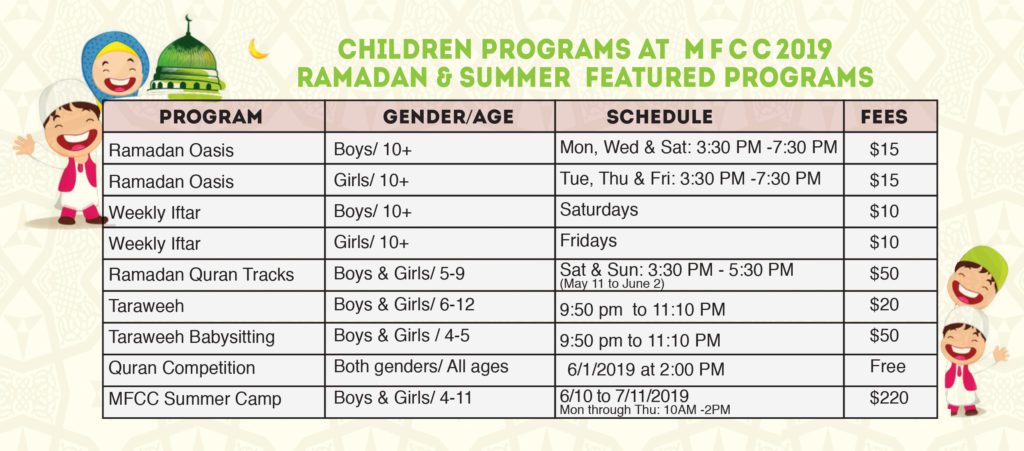
Ramadan Programs

For More Info call 708-598-6307