Mosque Foundation | Bridgeview, Illinois Logo
Mosque Foundation | Bridgeview, Illinois

Mosque Foundation

Treat Others As You Wish To Be Treated

First Friday Prayer is at 12:30pm. Second Friday Prayer is at 2:00pm.

Treat Others As You Wish To Be Treated


Throughout His book, Allah the Most High has emphasized the importance of treating others with the utmost respect and kindness. He says, speaking of His covenant to the people of Moses, “…And say and do to people that which is good.” In commanding our Prophet ﷺ, he says: “…And tell My servants to say and do that which is best; indeed the devil does spread strife between them; indeed the devil is a clear enemy to human beings.” The cornerstone of good character regarding interacting with others is that one treats them with that with which he wishes to be treated.

The Prophet ﷺ tells us: “Whoever wishes to be delivered from the fire and admitted into paradise, then his death is to come to him while he is in a state of belief in Allah and the last day and that he brings unto others that which he desires be brought onto himself.”

In another narration more specific to how Muslims are to treat one another, he says: “None of you will truly believe until you love for your brother what you love for yourself.”  Imagine what kind of community and people we would be if we implemented this amongst us. The husband treats his wife how he wishes to be treated; the wife treats her husband as she would like to be treated. Employers treat their employees as they would like to be treated if they were in their position. The children their parents, the parents their children, etc. These verses mentioned above and narrations essentially translate to one simple social guideline: “When dealing with another person, you see yourself and treat them accordingly.”

You must see others, especially your fellow Muslim brothers and sisters, as they have a portion of rights upon you and are owed an additional amount of respect and appreciation. You must see others as reflections of yourself as if you are looking into a mirror. The Prophet ﷺ says: “The Believer is the mirror of his brother; if he notices a discrepancy he corrects it.” I submit that the bulk of our social problems in the Muslim community would vanish if each of us saw ourselves in the eyes of the other when dealing with each other. Even in treating our deceased brother or sister, we pray for them as if we are praying for ourselves. The Prophet ﷺ says in this spirit: “You can never suffice everyone with your wealth, but suffice everyone instead with an approachable bright face and good character.”

In short, if you wish to have a rough idea as to how Allah will treat you on the Day of Judgment, you should look to how you treat others, for as you treat others in this life, you will be treated by Allah in the next. May Allah grant us all the best of character and best of manners with Allah ﷻ, with the Prophet ﷺ, with each other, and with our selves. Ameen.

Allah knows best.

By Sh. Ali Mashhour


Trying Our Best Is The Best We Can Do

If you think deeply and reflect on your path to Allah, you cannot help but become overwhelmed by the daunting nature of the journey ahead. Our path to Allah and salvation with Him is one of constant struggle and strain, an uphill path in which gravity itself is every step of the way pulling at your back. Allah describes this path of guidance and righteousness as a path of great difficulty, broken through with obstacles to be overcome. Allah says in chapter 90, verse 8-18 that which translates to: 

Have We not made for him two eyes? (8) And a tongue and two lips? (9) And have shown him the two ways? (10) But he has not broken through the difficult pass. (11) And what can make you know what is [breaking through] the difficult pass? (12) It is the freeing of a slave (13) Or feeding on a day of severe hunger (14) An orphan of near relationship (15) Or a needy person in misery (16) And then being among those who believed and advised one another to patience and advised one another to compassion. (17) Those are the companions of the right. (18)

Not only is the path itself inherently difficult, but all along the way, on either side of this path and on it are devils beckoning and calling and inviting off with promises of ease and respite and the fulfillment of fanciful dreams and notions. As Allah related to us, the only promise Iblees fulfills to humankind: 

[Satan] said, “Because You have put me in error, I will surely sit in wait for them on Your straight path. Then I will come to them from before them and from behind them and on their right and their left, and You will not find most of them grateful [to You]” (Quran 7:16-17).

[Iblees] said, “My Lord, because You have put me in error, I will surely make [disobedience] attractive to them on earth, and I will mislead them all. Except, among them, Your chosen servants” (Quran 15:39-40).

Imam Ahmad reported in his Musnad on the authority of Abdullah Ibn Mas’ood that he related: “The Messenger of Allah (ﷺ) drew for us a line and said gesturing to it ‘This is the path of Allah’. He then drew other lines jutting out of this line on its right and left others and said: ‘and these are contrary paths, and at the head of each is a devil inviting to enter.’ He then recited: And, [moreover], this is My path, which is straight, so follow it; and do not follow [other] ways, for you will be separated from His way. This has He instructed you that you may become righteous” (Quran 6:153).

Yet, despite this daunting and tedious nature of this path of ours, Allah has given us overwhelming hope, not in our own devices and abilities, but in Him. Our position on this path is to open our hearts and lives to Allah, to knock on the door of salvation ready for Allah to open it, not to break through it. As Allah said to Iblees: “This is a path [of return] to me [that is] straight. Indeed, My servants – no authority will you have over them, except those who follow you of the deviators (Quran 15:41-42).

Our duty on this path is as Allah has instructed: And seek help through patience and prayer, and indeed, it is difficult except for the humbly submissive [to Allah ] (Quran 2:45).

Allah’s Messenger (ﷺ) said, “Allah said, ‘I will declare war against anyone who shows hostility to a pious worshipper of mine. And the most beloved things my servants gain nearness to me are by fulfilling what I have obligated upon them. My servants continue to draw nearer and nearer to me by performing additional optional acts of worship (in addition to my obligations) till I come to love them. After which, I become their sense of hearing with which they hear, their sense of sight with which they see, their hands with which they grip, and their legs with which they walk. And if they ask Me, I will give them, and if they seek refuge, I will protect them; and I do not hesitate to do anything as I hesitate to take the souls of the believers, for they hate death, and I hate to disappoint them” (Bukhari: 6502).

By Sh. Ali Mashhour

ZAKAT Q&A

Zakat: The Third Pillar of Islam

 Introduction with answers to 15 frequently asked questions

One of the most important principles of Islam is that all things belong to God, and human beings hold wealth in trust. The word Zakat means both ‘purification’ and ‘growth.’ Our possessions are purified by setting aside a portion for those in need, and like the pruning of plants, this cuts back balances and encourages new growth. Muslims calculate their Zakat individually. For most purposes, this involves the payment each year of 2.5% of one’s Zakatable wealth.

Those who are pious may also give ‘Sadaqah,’ which is another form of charity. Sadaqah is preferably given in secret. Although this word can be translated as ‘voluntary charity,’ it has a broader meaning. The Prophet ﷺ said, “Even greeting your brother or sister with a smile and cheerful face is charity.”

The Prophet ﷺ also said, “Charity is a necessity for every Muslim.” He was asked: ‘What if a person has nothing?’ The Prophet ﷺ replied, “He should work with his own hands for his benefit and then give something out of such earnings in charity.” The Companions asked: ‘What if he is not able to work?’ The Prophet ﷺ said, “He should help the poor and needy.” The Companions further asked, ‘What if he cannot do even that?’ The Prophet ﷺ said, “He should urge others to do good.” The Companions asked, ‘What if he lacks that also?’ The Prophet ﷺ said, “He should restrain himself from doing evil, that is also charity.”

Zakat is the third pillar of Islam. This graceful charitable giving represents the unbreakable bond between members of the Muslim community, whom Prophet Muhammad ﷺ described to be “like the organs of the body, such that if one [organ] suffers then, the others rally in response.” The Mosque Foundation helps thousands of Muslims fulfill this important pillar of Islam every year. These Zakat contributions help many needy families.

Here you will find quick answers to frequently asked questions about Zakat. If you want further explanations, we invite you to speak to an Imam. To calculate your Zakat, use our convenient Zakat Calculator. Both the calculator and answers to the questions are based on respected Fiqh references. They are also reviewed and approved by Muslim scholars. 

What is Zakat?

Zakat does not refer to charitable giving out of kindness or generosity, but to the systematic giving of 2.5% of one’s Zakatable wealth each year to benefit those who are financially less advantaged. This rate applies to cash, gold, silver, and commercial assets. By giving this small portion of one’s wealth, Muslims purify their wealth and please the Creator. Zakat is the third of five pillars of Islam, which means it is an essential act of worship that Muslims must fulfill. 

Who pays Zakat?

All Muslims who meet the financial threshold of Zakat, as indicated in Nisab—(see below), are required to give a portion of their wealth annually—to help those in need. 

How much Zakat is due?

Zakat is calculated based on the net assets one possesses at the end of one year. To calculate how much Zakat you owe, the Mosque Foundation created a convenient Zakat calculator found here

When is Zakat due?

Zakat is due after one Lunar (Hijri) year starting from either the first day you acquired the amount of Nisab or the day you paid your Zakat the previous year. Most Muslims give their Zakat during Ramadan when Allah magnifies the rewards of good deeds. Zakat becomes a religious obligation upon a Muslim after a period of one lunar year passing while he or she owns the Nisab. And if you always possess the minimum Nisab value, then Zakat is due once every lunar year at a date of your choosing.

What is ‘Nisab’?

Nisab is a minimum amount of wealth you must own for a full Lunar year to be liable to pay Zakat. It is estimated at 3 ounces of pure gold. The current Nisab value is $15,200. Nisab is the minimum threshold of wealth a Muslim holds to pay Zakat.

If I don’t keep track of whether or not I own Nisab for an entire year, what should I do?

Since most Muslims in the USA own at least the value of Nisab, you don’t have to keep track of when you acquired this amount. Also, since you are encouraged to give in charity more than the minimum obligatory Zakat, you should assume that you have always owned the Nisab value. Therefore, to simplify matters, choose a specific date of the lunar calendar every year, such as the 25th of Ramadan, calculate the total value of your Zakatable wealth on that date, and give 2.5% of it or the rate that applies to the type of wealth you own.

Do I have to possess the amount of Zakatable wealth for a complete Lunar year before I have to pay Zakat on it?

No. You must only possess the value of Nisab for the whole year. Therefore, as long as you have a minimum amount of Nisab for the year, you assess your Zakatable wealth on your Zakat due date, regardless of when you acquired this wealth or part of it. 

How does the Mosque Foundation distribute Zakat?

The Mosque Foundation distributes Zakat to vulnerable neighbors in the Chicago area to fulfill their essential needs.

What is Zakat-ul-Fitr?

Zakat-ul-Fitr, also known as Fitrah, is the obligatory charity paid by all Muslims throughout Ramadan. It is also called Sadaqat-al-Fitr, or Zakat-al-Fitrah. Zakat-ul-Fitr is currently the equivalent of $15 per household member.

What is the difference between Zakat and Sadaqah?

In the language of the Quran, Zakat and Sadaqah are similar. But in practice, Sadaqah is the term used to indicate voluntary charitable giving to both Muslims and non-Muslims in any amount. Zakat, on the other hand, is mandatory, with a fixed minimum rate, usually given to Muslims in need.

What is Zakatable wealth?

Zakatable wealth is what you own, whether in your possession or with others, except for the properties and belongings you use, such as your house, car, clothes, and business equipment. Also, Zakatable wealth is what remains with you after meeting the needs and expenses of yourself and your family. It is not based on the income you make during the year. Instead, it is based on what remains with you after you take care of your family’s expenses. This wealth can be in the form of cash, gold, stocks, business commodities, or other wealth.

How does the Mosque Foundation Zakat calculator work?

The Mosque Foundation provides a Zakat calculator covering the most common Zakatable assets for people living in America. This calculator is based on respected Fiqh references and reviewed by Muslim scholars. However, it does not cover every Zakatable item, so please consult with Muslim scholars for items not mentioned. We encourage you to calculate your Zakat using our calculator and to pay it online so that we may disperse it to qualified recipients.

If I loan a friend money, and it is due in six months, do I have to pay Zakat on this loan?

Although the amount of the loan is not yet in your possession, you still own it. So you have to pay Zakat on it if you expect it back (good loan). However, if the loan is due and you asked for it, and the borrower can’t pay you back (bad loan), you are not required to pay Zakat on it until it is in your possession. Once you receive it, you pay Zakat on it for one year only.

How much Zakat do I have to pay on behalf of my business?

You do not pay Zakat on your equipment, such as refrigerators, cashier devices, and other equipment and tools. Even if you own the business property, you don’t pay Zakat on it. However, you must pay Zakat on the wholesale price of all inventories and other Zakatable assets such as business cash balance, as mentioned in the Zakat calculator worksheet.

How do I pay Zakat on my service-providing company?

There is no Zakat due on the value of the equipment if it is used for business. But if you own this company, you should combine your Zakatable wealth with that of the company. The Zakat is payable on what you hold in Zakatable wealth after a full year of meeting your expenses and those of the company.

Tenacious Unremitting Repentance

“O you, who have believed, repent to Allah with sincere repentance. Perhaps your Lord will remove from you your misdeeds and admit you into gardens beneath which rivers flow [on] the Day when Allah will not disgrace the Prophet and those who believed with him. Their light will proceed before them and on their right; they will say, ‘Our Lord, perfect for us our light and forgive us. Indeed, you are over all things competent” (Quran: 66:8).

“…And turn to Allah in repentance, all of you, O believers, so that you may succeed” (Quran 24:31).

On the authority of Abu Musa Al-Ash’ari (Allah be pleased with him), the Prophet ﷺ said: “Allah extends his hand in the night for the sinners of the day to repent, and extends his hand in the day for the sinners of the night to repent. He will continue to do so until the sun rises from the west (Muslim 2759).

On the Authority of Ibn Umar (Allah be pleased with him), the messenger of Allah ﷺ said: “Whoever repents before his soul is being extracted from his body Allah will accept his repentance” (At-Tirmidhi 3537).

In essence, the entirety of the Quran is a book of hope for all who hear its verses. Not one verse in the Quran is designed to instill a sense of hopelessness in the reader. On the contrary, Allah clarifies that sadness, sorrow, despair, and forfeit are all the devil’s work to hinder us from attaining salvation and enlightenment and reaching our full potential. 

The Quran and the Sunnah encourage that we never give up, that it’s never too late to turn over a new leaf, to start a new chapter. We are constantly reminded and inspired by the stories of those who preceded us on this path of salvation that people can and do change, even if only with their final breath. 

It’s paramount to understand something about the Quran when reading it: any time fear is instilled in the reader, when the hellfire is mentioned, when the wrath of Allah is mentioned, when the tales of the demise of the wicked and stubborn are told, these verses are to instill fear, yes, but a healthy fear, a religious pious fear, nothing more. In other words, this fear is balanced. Its sole purpose and function is to instill a fear that will propel the person toward Allah more rapidly and keep the person focused and away from the devil’s traps. This is healthy fear intended to keep the believer vigilant and focused, and unwavering.  

Suppose your fear, however, overtakes your mind and instills a sense of deprivation and disillusion, and causes you to tread the path to Allah more slowly or diverge or feel hopeless in the slightest. In that case, you can be sure this is not from Allah, and you have completely misunderstood the point of Allah’s revelation. Allah has articulated to us a general over-arching light under which to view the entirety of his revelation and sending of his Prophet Muhammad ﷺ as he says “…And we have not sent you (O messenger Muhammad) but as a mercy for all of the creation” (Quran 21:107).

Hence, the Quranic verses and narrations of the Prophet ﷺ should be viewed through this lens. Yes, there are outright terrifying verses of the Quran, but they are there to propel us to good and steer us away from evil, not to make us give up or feel hopeless. We are to repent, and we are guaranteed to fall again after that repentance because we are but perfectly imperfect humans. So we repent again and fall and repent and fall until we meet Allah. We walk the path to Allah, and we stumble and fall and get distracted and trip and at times even crawl, but we remain on the course filled with unwavering audacious hope in Allah. As the Prophet ﷺ has taught us that none of us will enter paradise based on our deeds, but rather by the overwhelming mercy of Allah All-Mighty.  

By Sh. Ali Mashhour


Eidul Fitir Celebration

Al-‘Ihsaan – Good Citizenship

A topic we have addressed in the past is one that touches every one of us, and that is the construct of ‘ihsaan, seeking excellence, as defined to us by our beloved Prophet Muhammad ﷺ in the following Hadeeth related by Abu Ya’la Shaddad bin Aws:

“Verily Allah has prescribed ‘ihsaan (perfection) in all things. Thus if you kill, kill well, and if you slaughter, slaughter well. Let each one of you sharpen his blade and let him spare suffering to the animal he slaughters” (Muslim).According to Islam, the Hadeeth appears to contain a simple instruction about the etiquette of slaughtering for the beginning learner. However, scholars categorize this Hadeeth as part of those touching upon Islamic aspects such as the Hadeeth on actions judged by intentions. This particular Hadeeth addresses all the doors of Islamic knowledge and practice.

So what is it that the Prophet ﷺ is informing us in these few lines? First, Allah ﷻ both farada and qadara made obligatory and predetermined, ‘ihsaan in all matters. Prophet Muhammad ﷺ explains the obligation in the lines that follow, illustrating how a Muslim is obligated to slaughter minimizing the pain of the animal.

 This literal depiction demonstrates the many meanings in the word ‘ihsaan, which incorporates perfection, mercy, compassion, promoting good, and avoiding harm. Allah predestined that ‘ihsaan exists in everything, and He obligated us to emulate His attribute of ‘ihsan in all of our actions.

Muslims mistakenly presume that ‘ihsaan refers only to worship matters such as perfecting salat, siyam, zakat, and Hajj. But the Hadeeth mentioned above dispels this assumption by clarifying that ‘ihsaan must be adopted in every action Muslims take on even when it comes to slaughtering an animal or cutting a tree. Imam Ahmad narrates that we were obligated to hide the blade from an animal we planned to slaughter to prevent it from panicking. Islam obligates Muslims to be merciful and compassionate to the feelings of an animal that will be slaughtered. Allahu Akbar! How beautiful is our religion! Islamically, even killing harmful animals such as snakes or rodents must also be done mercifully, just as a woman entered hellfire as Prophet Muhammad ﷺ informed us, for torturing a cat.

Therefore, Prophet Muhammad ﷺ reminds us to practice ‘ihsaan in the biggest and smallest of matters. This is because ‘ihsaan is a foundational element of our Islam. This ties into the belief that as Muslims, living in this country, practicing ‘ihsaan means being a good citizen and abiding by the laws of the land. This includes being honest, compassionate, respectful, and responsible.    

The laws of this country do not ask us to go against Islam’s teachings, and the majority of its rules go hand-in-hand with Islam. Unfortunately, it is often the case that when Muslims are not obeying laws, they are, in reality, not being good Muslims. A good Muslim is a good citizen, and Islam does not ask us to break the law.

As Muslims, we should strive to be honest in all our affairs, including legal transactions and public duties. A Muslim should be recognizable as a muhsin when he or she is a professional, a neighbor, a college student, a visitor at the library, a customer in the store, a driver on the street, an attendee of a celebration at a hall, etc. A Muslim should not be recognized by their lack of ‘ihsaan. For example, sometimes Muslims are labeled as those who bend the rules or are irresponsible and careless.

Practicing good citizenship is especially important considering the challenges of Islamophobia we face as an American Muslim community. Therefore, brothers and sisters, I remind you and remind myself to practice ‘ihsaan in all of our matters and affairs no matter how insignificant the matter might seem.

Allah ﷻ states, “Verily, Allah enjoins justice, and ‘ihsaan and giving help to relatives, and He forbids immoral sins, evil and tyranny. He admonishes you, so that perhaps you may take heed” (Quran 16:90).

By Sh. Jamal Said

Muslim Charities Need Your Support this Ramadan to Assist Struggling Families


For over thirty years, the Mosque Foundation has been hosting nonprofit organizations every night of Ramadan to raise funds from our generous community. Your support has touched the lives of countless families locally, nationally, and globally. The projects you have supported include educational initiatives, civic fellowship, strengthening other Masajid, feeding the hungry, housing the homeless, treating the ill, and so much more. Over the years, we have raised tens of millions of dollars.

Ramadan is a time for charity and compassion, especially this year, as we are going through unusual global hardship and suffering. COVID-19 is a grave danger everywhere, but especially in vulnerable communities. 

Donate every day of Ramadan to help those suffering during this global pandemic. The families who benefit from these organizations depend on Allah first and foremost, and then on you for help. COVID-19 may have shut our doors, but do not let it close your hearts. We call upon our community to directly support the following charitable organizations. 


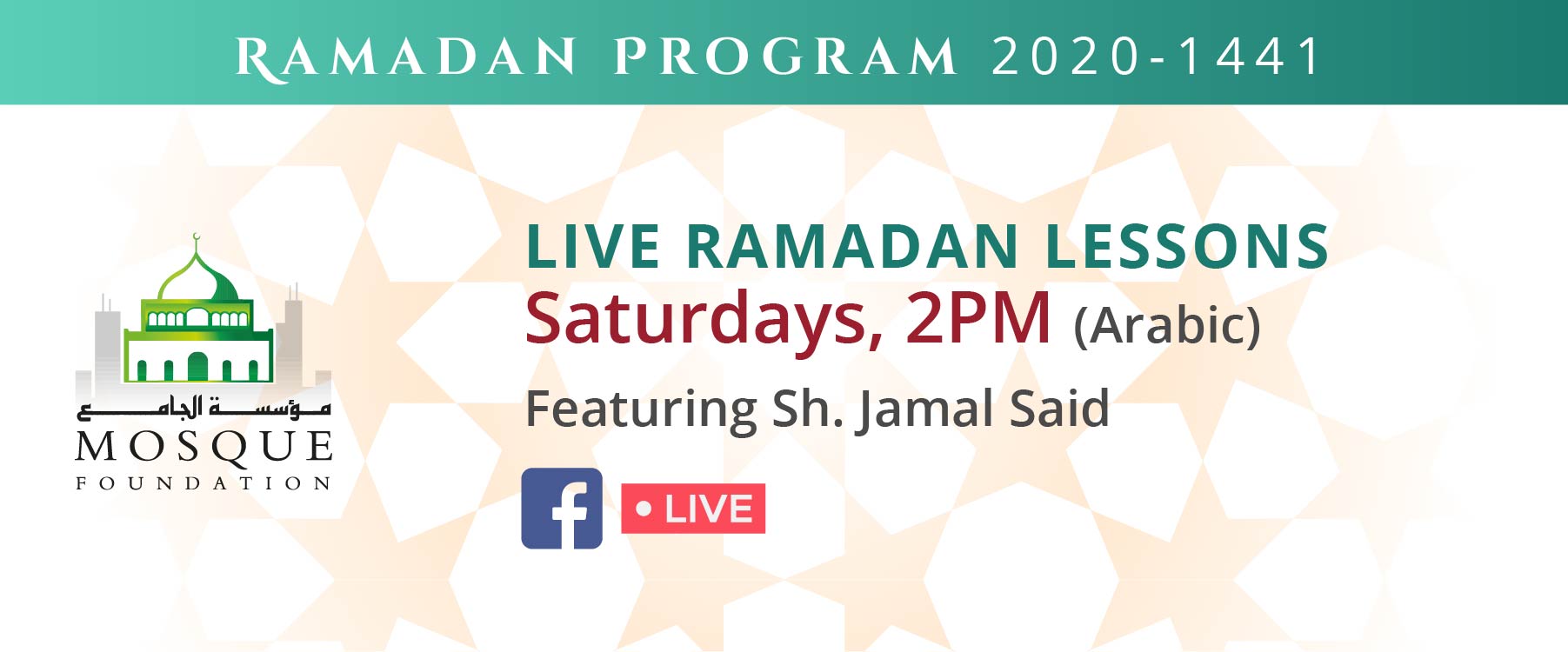
Live Ramadan Lessons

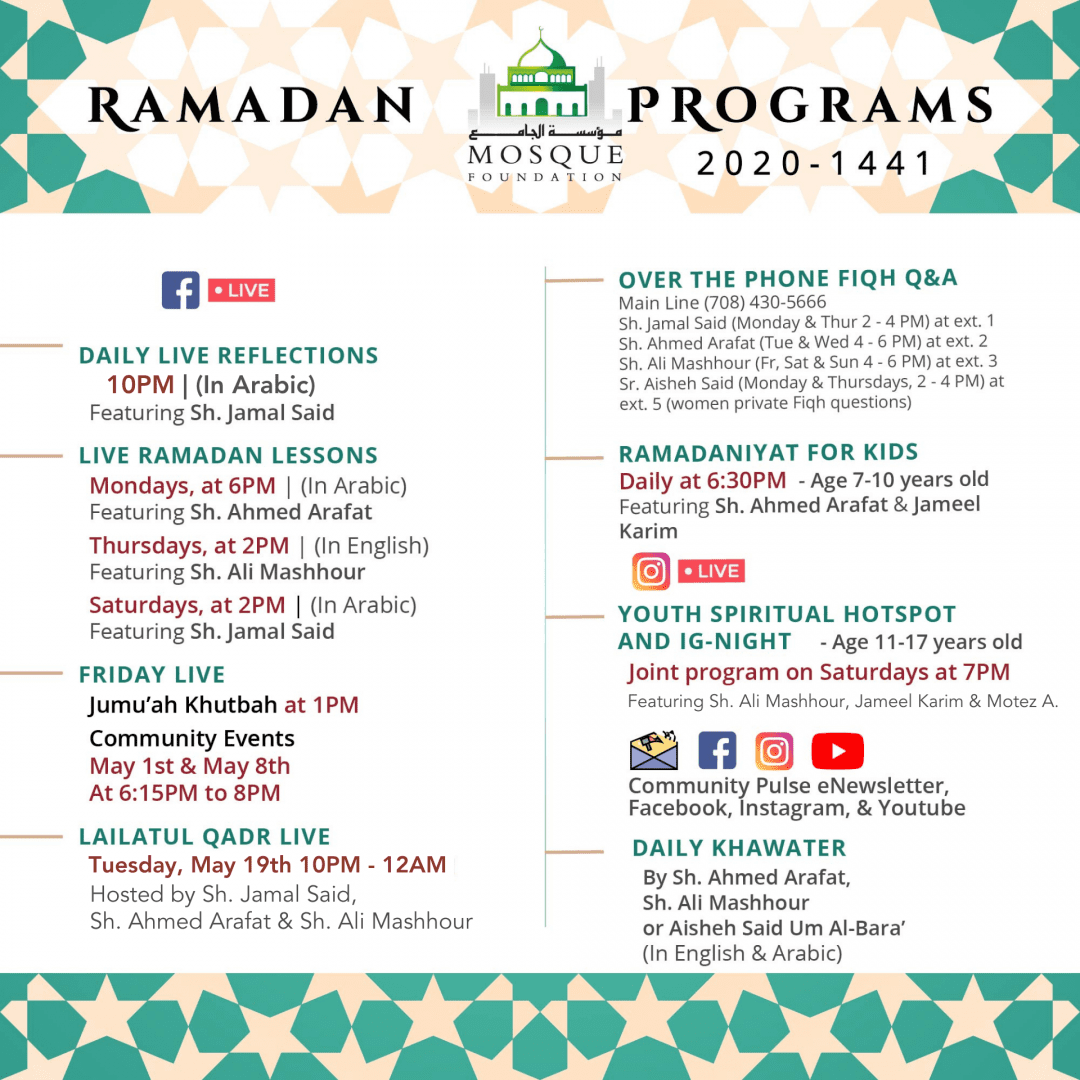
Ramadan Programs

Facebook Live

إعلان شهر رمضان والعيد 


إعلان شهر رمضان والعيد

تعلن مؤسسة الجامع بناء على قرار مجلس الفقه لأمريكا الشمالية ان يوم الجمعة ٤/٢٤ هو اول ايام شهر رمضان المبارك وعليه فصلاة التراويح تبدا يوم الخميس، لكنها ستكون في بيوتكم بسبب مرض كورونا. كما تعلن ان يوم الأحد ٥/٢٤ هو يوم عيد الفطر المبارك. نسال لنا ولكم القبول.

Ramadan Announcement 

Assalamu-Alaikum!

The Mosque Foundation has decided to follow ISNA’s Fiqh Council of North America (FCNA) to determine the first day of Ramadan 1441H and first day of Shawwal 1441H.  According to ISNA’s Fiqh Council, the first day of Ramadan 1441H will be on Friday, April 24, 2020 and hence the first Taraweeh prayer will start on Thursday, April 23, 2020 night and first day of fasting will be on April 24, 2020.  The Mosque Foundation made this decision in order to unite the neighboring communities and celebrate one Eid Inshallah!

The following is the rationale from ISNA’s Fiqh Council:

The Fiqh Council of North America recognizes astronomical calculation as an acceptable Shar’i method for determining the beginning of Lunar months including the months of Ramadan and Shawwal.  FCNA uses the criteria of European Council of Fatwa and Research (ECFR), which are that somewhere on the globe, at the sunset, the elongation should be at least 8 degrees and moon should be at least 5 degrees above horizon. If these conditions are met, the new crescent will be visible somewhere on earth. Hence the new lunar month will start the next day, otherwise it will start on the day following next day. On the basis of this method the dates of Ramadan and Eidul Fitr for the year 1441 AH are established as follows:

Ramadan 1441 AH:

The Astronomical New Moon is on Thursday, April 23, 2020 at 2:27 Universal Time. On that day, everywhere in North and South America at sunset the elongation is at least 8 degrees and moon is at least 5 degrees above the sun. Therefore, first day of Ramadan 1441 is on Friday, April 24, 2020, insha’Allah. Tarawih prayer will start on Thursday night.

Eid ul-Fitr 1441 AH:

The Astronomical New Moon is on Friday, May 22, 2020 at 17:40 Universal Time. On that day there is no place on earth where at sunset the elongation is 8 degrees and moon is 5 degrees above the sun. Therefore Shawwal 1441 cannot start the next day. Hence first day of Shawwal is on Sunday, May 24, 2020, insha’Allah.

May Allah accept our deeds and forgive our sins ameen. Ramadan Mubarak

One Human Race


“O humankind! Indeed, We created you from a single male and a single female and made you into peoples and tribes so that you may ‘get to’ know one another. Surely the most noble of you in the sight of Allah is the most righteous among you. Allah is truly All-Knowing, All-Aware” (Quran 49:13). 

On August 12, 2017, a self-identified white supremacist plowed his car into a crowd of counter-protesters, killing Heather Heyer and injuring 19 other people as race riots broke out in Virginia. Unfortunately, Virginia historically reminds us of an incident of unimaginable racism; that is, the case of Ota Benga, who spent part of his life in Virginia. Ota Benga was an African pygmy who was kidnapped from Congo to be featured in the anthropology exhibit at the St. Louis World’s Fair, Missouri, in 1904, and a human zoo exhibit at the Bronx Zoo in 1906. Samuel Philips Verner, an American businessman and African missionary, found out that Benga, being four feet, two inches tall, and having pointed teeth, was an excellent example to illustrate evolution! This was one of the darkest moments in human history, humans caging other humans in zoos. This clearly exemplified the ugly face of racism. Sadly, on March 20, 1916, Ota Benga, age 32, committed suicide by shooting himself with a pistol, ending the short and tragic life of the “missing link.”

In his Descent of Man, Charles Darwin, author of the famous Origin of Species, writes: “At some future period, not very distant as measured by centuries, the civilized races of man will almost certainly exterminate and replace the savage races throughout the world.” Whether Darwin was spelling racism here or not, the ugly truth is that social Darwinism emerged to justify a series of moral crimes and mass destruction, as in the case of eugenics and Nazism. For instance, from the 1920s to the 1970s, state-run eugenics and the horrifying compulsory sterilization victimized more than 60,000 Americans in 33 states. Among the targeted people were African Americans and children from low-income families. North Carolina was the first state in the US to compensate victims with a payment of about $20,000 in 2014. 

Currently, chants like “Go back to your country” by US political leaders and their supporters are heinous examples of modern racism in the land of “immigrants,” a title that ironically applies perfectly to the families of countless politicians and policymakers! It is alarming that such atrocious voices evoke and revive the racist roots that are not pulled out from many hearts yet. Such racist remarks are not slips of the tongue or unintentional mistakes. They are deliberate, made to feed the rage of a targeted group to draw more support and attract more voters! That is why the supporters of such politicians cheer as they hear the vicious racist comments, which these politicians want. They want votes even if they rely on divisive rhetoric or racist remarks. 

To uproot racism, the Quran, as in (49:13), reminds us of our unifying origin: Adam and Eve, who make humanity a single family under One God. Interestingly, the phrase “human being” in Arabic is Adami, which means “the one who belongs to Adam.” Similarly, the Quran addresses humans as “Banu Adam” (the children of Adam). As the world celebrated the victory of Barack H. Obama as the first Black president, I remembered that Anwar Sadat of Egypt was Black. Yet, no one noticed simply because the problem did not exist! Such vocabulary of colors has no place in the heart that is instructed to prostrate before God five times a day, regardless of color, culture, race, rank, language, or locality. It is for that reason that the Prophet of Islam considers racism a form of ignorance. Al-Bukhari records the Prophet’s correction for Abu Dharr’s abuse: 

“We went to Abu Dharr and saw that he had a mantle over him, and his servant had one like it. We said: Abu Dharr, had you used the two mantles together, it would have been a complete beautiful garment for you. Thereupon he said: There was a dispute between a brother whose mother was a non-Arab and me. I reproached him for his mother. He complained against me to Allah’s Prophet. As I met him, the Prophet said: Abu Dharr, you are a person who still has remnants of the days of ignorance. Thereupon I said [as a justification]: Allah’s Messenger, he who abuses other people, they abuse (in return) his father and mother. Affirmatively, the Prophet responded: Abu Dharr, you are a person who still has remnants of ignorance in him! Your servants are your brothers. Allah has put them in your care, so feed them with what you eat, clothe them with what you wear, and do not burden them beyond their capacities, but if you overburden them, then help them.”

Thanks to the Prophet’s directions, Abu Dharr’s servants became like brothers who dressed exactly like him. This spirit of universal brotherhood is captured in Imam al-Sayyadi’s treatise, Hadiqat al-Ma’ani fi Haqiqat al-Rahim al-Insani, wherein he listed four aspects of blood relations. The first was what he called the “Adami relatives,” which he thought was supported by the Quran: 4:1. “People, be mindful of your Lord, who created you from a single soul, and from it created its mate, and from the pair of them spread countless men and women far and wide; be mindful of God, in whose name you make requests of one another. Beware of severing the ties of kinship: God is always watching over you.” Furthermore, he sees the different “colors” as an element in making the beautiful human garden. He added that universally any nation that goes against the rights of the human garden would suffer self-punishment, and any nation that administers justice in this regard will grow and prosper.