
Mosque Foundation | Bridgeview, Illinois Logo
Mosque Foundation | Bridgeview, Illinois

Mosque Foundation

Three Disciplines for Nurturing Istiqamah

First Friday Prayer is at 12:30pm. Second Friday Prayer is at 2:00pm.

Three Disciplines for Nurturing Istiqamah

Imagine a person dedicating an entire month accumulating a large amount of money tirelessly and suddenly throwing it away! How would you view that person? Unfortunately, this is the condition of many people who earnestly worship Allah ﷻ during Ramadan and turn to sin or neglecting their religious duties after Ramadan. The Quran illustrates this condition stating, “And do not be like the one who untwisted their spun thread after it was strongly done” (Quran 16: 92). In this verse, we find a reproach to those who made a covenant with Allah ﷻ but failed to keep it. The verse could also apply to those who exert their utmost in Ramadan and dedicate time for praying, fasting, giving, forgiving, Qiyam, Quranic recitations, and ‘Itikaf and, yet, abandon most of these acts of worship as Ramadan comes to an end. The following attempts to outline three basic tools that can help us maintain the great values gained during the month of Ramadan.

1- Ikhlas (Sincerity)

If you feel that you are neglecting your religious and moral duties after Ramadan, you should sincerely ask yourself why you were so committed to worship in Ramadan. Was it for seeking people’s approval or for seeking Allah’s pleasure? If your Ramadan worship was dedicated to Allah as the only Witness for and Compensator of your deeds, you successfully managed to meet the condition of Ikhlas without which our deeds would be rejected.


One way to test your level of Ikhlas in Ramadan is to examine your life after Ramadan. If you genuinely had Ikhlas in Ramadan, you should maintain your religious duties after Ramadan since the God of Ramadan is the same God of Shawwal and the other months of the year! If you managed to pray eleven rak’at after Ramadan’s ‘Isha’, then five-rak’ at of Qiyam, for instance, should not be an impossible feat. If you fasted correctly in Ramadan, even though you could have broken your fast without anyone noticing, you should have some remnants of muraqabah (living in the presence of Allah) in your heart. To maintain this muraqabah after Ramadan, make sure that you do some good deeds entirely for Allah ﷻ without allowing anyone to know. In this way, you are training yourself to be satisfied with Allah’s sole knowledge of your actions, thereby resisting working only to gain people’s approval.

2- Salat (Prayer)

Praying five times a day is a great way to maintain Istiqamah (steadfastness). Let us rediscover the power of the Muslim prayer in helping us stay on the Straight Path. During Salah, as illustrated by sujud (the prostration position), we declare Allah’s supremacy and our complete submission to His Will by placing our forehead on the ground in complete humility. Therefore, Salat represents an implicit commitment to obeying Allah and a solemn promise to stay away from haram. So when we make sujud, we remember our sins and shortcomings and commit to renewing our covenant of obeying Allah. It is like saying, “Oh Allah, we are sorry for the sins we committed; so, forgive us.” That is why sujud is associated with crying as the Quran describes the righteous’s prayers, “They fall down on their faces in tears” (Quran 19:58).

Accordingly, we should view sujud as a means of ‘daily repentance’—something that protects against Shaytan’s (satan) attempts to make us despair of Allah’s mercy. Shaytan works to dissuade us from maintaining the level of ‘Ibadah we have by making us feel guilty of hypocrisy if we decide to go to the Masjid.

Essentially, Shaytan cannot defeat a practicing Muslim who always maintains daily prayers and recognizes the significance of sujud. If a Muslim sins Thuhr, they have an appointment with Allah ﷻ at ‘Asr to wash away this sin and renew the covenant with Allah. If the same person sins after ‘Asr, they will get rid of it at Maghrib and restore Allah’s relationship. This happens five times a day. In other words, Allah gives us five main, obligatory chances to start a brand new life, follow His Way, and avoid the paths and whisperings of the Devil. Thus through Salat, and particularly sujud, you have the chance to wash away your past sins and embrace a new beginning every day.

In this way, Salat is the fountain of hope for everyone who tries sincerely to overcome Shaytan’s whisperings and to nurture their spirituality. The late Sh. Muhammad Mutwalli Ash-Sha’rawi once said—with some modifications and additions—: “Can you imagine that your car will break down if your mechanic checks it out five times a day? It will most likely not simply because if the mechanic notices a problem, he will fix it right away. Similarly, Muslims present themselves five times a day before Allah to check the level of their faith and character and to cleanse themselves from the dirt of sins.”

Imam al-Bukhari and Imam Muslim reported, on the authority of Abu Hurayrah (R), that the Prophet ﷺ once asked his Companions, “‘What do you think if one of you had a river running past one’s door and one bathed in it five times a day, would there be any trace of dirt left on him?’ They replied, ‘No trace of dirt would remain on him.’ Upon this, the Prophet ﷺ replied: ‘This is the case with the five daily prayers, through which Allah washes away our sins.'”

In contrast, abandoning Salat will result in being easily trapped by Shaytan and following our whims and desires. In reading the Quran carefully, we find a close connection between abandoning Salat and following our lusts and desires. Allah ﷻ says, “There came after them an evil generation that neglected their prayers and followed their whims; so, loss awaits them—except those who repent and have faith and do good deeds. Such will enter Heaven and will not be wronged at all” (Quran 19: 59-60).

3- Du’aa (Supplication)

Pray that Allah guides you to His Straight Path and keeps you guided. The Prophet ﷺ taught us to pray, “O Allah, Who turns the hearts, keep our hearts steadfast upon Your Deen.” For such a supplication to be effective, it requires sincerity, certainty, and action. Pray to be guided sincerely as you would ask to be rescued if you were stranded in the middle of the ocean on a wooden board. Pray with certainty and hope and do not belittle yourself since Allah loves those who turn to Him in repentance. Be practical in your prayers by having good friends, and staying away from bad ones you know will keep you away from Allah.

We ask Allah to lead us from sin to forgiveness, from darkness to light, from fear to trust, and from hatred to love. O Allah kindle in our hearts Your love, the love of those who love You, and all that You love. Ameen. 
 

Spiritual Planning for the Summer

In life, anything worthwhile requires careful planning and a strategic approach. It is a principle rooted in the teachings of the Messenger of Allah ﷺ, which reminds us that success, whether it occurs spiritually, personally, or within a family setting, requires intentionality and mindfulness. The Messenger of Allah ﷺ said, “Any matter of importance that is not commenced with the praise of Allah remains defective” (Abu Dawud). It is a way of life that ensures our actions are purposeful and productive.

For believers, this means not only planning for worldly matters but also dedicating equal, if not more, attention to spiritual planning. Just as we meticulously manage our finances, we must invest in nurturing our souls and seizing the opportunities Allah provides.

Two of Allah’s greatest blessings—good health and free time—are often taken for granted. The Messenger of Allah ﷺ said: “Two blessings which many people squander: Good health and free time” (Sunan Ibn Majah). These gifts offer immense potential for growth but can also lead to ruin if misused. 

Our children’s lives are profoundly shaped by these blessings, and as parents, we should recognize their importance. With summer just around the corner, families, especially youth, are finding themselves with more free time. There is a great opportunity for growth during this season, but it also carries the risk of wasting potential. As parents, we must ask ourselves: How can we use this time to strengthen our bond with our children and guide them toward meaningful pursuits?

During his lifetime, the Messenger of Allah ﷺ was a master at building others up, particularly the youth. His interactions were marked by empathy and care, making people feel valued and respected. For instance, when a young boy grieved over his pet bird, the Messenger of Allah ﷺ comforted him with compassion, teaching us the importance of connecting with others on a personal level. Anas bin Malik reported that the Messenger of Allah used to mix with us to the extent that he would say to a younger brother of mine, ‘O Aba `Umair! What did the Nughair (a kind of bird) do?” (Sahih al-Bukhari)

As parents, we can emulate this example by engaging with our children thoughtfully, helping them see life as more than just fleeting pleasures. By instilling a sense of purpose and self-worth, we can guide them to approach life with a refined and elevated outlook.

Life is precious and fleeting. The Messenger of Allah ﷺ reminded us to “take advantage of five before five”: youth before old age, health before sickness, wealth before poverty, free time before becoming busy, and life before death (Shu’ab al-Imān). These teachings urge us to prioritize what truly matters. For youth, this perspective is transformative. Their focus shifts from immediate gratification to long-term growth, enabling them to lead lives of integrity and responsibility.

Today’s youth face significant challenges, including a lack of commitment, patience, and self-control. These issues contribute to societal problems such as broken relationships, unstable careers, and mental health struggles. As parents, we must address these challenges by fostering resilience, responsibility, and a sense of duty in our children.

Summer, often seen as a carefree season, can be a turning point in a young person’s life. It can either be a time of growth or a period of regression. Parents must ensure that their children’s summer activities—whether vacations, community service, or personal development—contribute positively to their character and faith.

As we approach summer, let us view it as an opportunity for spiritual and personal growth, for ourselves and our families. May Allah bless this time, strengthen our faith, and protect us and our children from all sources of corruption.


Imam Basheer Abdeen

Ramadan: A Journey of Spiritual Liberation and Divine Mercy

The Messenger of Allah ﷺ said: “There has come to you Ramadan, a blessed month, which Allah has enjoined you to fast. In it the gates of heaven are opened, the gates of Hell are closed, and every devil is chained up. In it Allah has a night which is better than a thousand months; whoever is deprived of its goodness is indeed deprived” (Sunan an-Nasa’i).

Ramadan is a manifestation of divine beauty and love upon Allah’s servants. As we approach this sacred month, we should feel a profound sense of awe and inspiration at Allah’s generosity. Ramadan is not merely a time for fasting, praying, and reading the Quran; it is an opportunity to deepen our spiritual connection with Allah, embracing the profound love and beauty that this month offers.

The Messenger of Allah ﷺ said: “(Allah says) Fasting is for Me and I shall reward for it. The fasting person rejoices twice: when he breaks his fast and the day when he meets his Lord. And the smell that comes from the mouth of the fasting person is better before Allah than the fragrance of musk.” (Sunan an-Nasa’i). This hadith reminds us that Allah cares about even the smallest details of our lives—such as our breath. He acknowledges that leaving our desires is not easy and that our breath while fasting may be unpleasant to others, yet it signifies our sacrifice and dedication to Him.

Allah tells us that Ramadan is the month when He sent down the guidance He chose for us, showing us how to live. Although many paths and choices exist in life, Allah assures us that His way is in our best interest. The Quran offers beautiful guidance, demonstrating how to practice self-discipline and rise above self-indulgence. We see this modeled by the Prophet ﷺ, who remained loving and compassionate no matter how challenging his circumstances.

Through Ramadan, Allah empowers us to overcome our lower nafs (the part of ourselves inclined toward wrongdoing) each day. This is the ultimate liberation because our worst enemy is often our own base desires. Allah’s mercy and love shine through acts of worship, which help us transcend our limitations and discover our true potential. We may doubt our ability to become better people—perhaps recalling that past Ramadans didn’t match our expectations—but Allah reassures us that He desires ease for us, not hardship.

If we fast during Ramadan with belief and submission, trusting in Allah and embracing His love, He promises to forgive all our sins. As our beloved Prophet ﷺ said, “He who fasts during Ramadan with faith and seeking his reward from Allah will have his past sins forgiven; he who prays during the night in Ramadan with faith and seeking his reward from Allah will have his past sins forgiven; and he who passes Laylat al-Qadr [Night of Decree] in prayer with faith and seeking his reward from Allah will have his past sins forgiven” (Bukhari and Muslim).

Every night in Ramadan, Allah saves people from the Hellfire and grants immeasurable rewards for their worship. The Prophet ﷺ said, “At every breaking of the fast, Allah has people whom He frees (from the Fire), and that happens every night” (Sunan Ibn Majah). As we anticipate this blessed month, let us do so with humility, hope, and the best opinion of Allah. Leave past shortcomings behind—do not let them sour your experience. Never doubt Allah’s mercy or His desire to lighten your burdens.

By Imam Basheer Abdeen

Ramadan: More Than Rituals

In Ramadan, many focus on fasting, night prayers, and completing the recitation of the Quran. While these are integral aspects of the holy month, deeper lessons are often overlooked.

Ramadan is not about abstaining from food but about understanding the value of what we consume. It is not only about long hours of prayer but also about how we manage our time, including our sleep. It is not just about completing multiple Khitmahs of the Quran but about truly engaging with its message.

One of Ramadan’s key spiritual benefits is the ability to empathize with those who struggle daily with hunger. While many of us plan elaborate Iftar meals, millions around the world are uncertain about their next meal. For some, breaking their fast might mean nothing more than a piece of bread or a sip of water.

The Quran reminds us:

“Eat and drink, but do not waste. Surely, He does not like the wasteful”  (Quran 7:31).

This verse teaches that Ramadan is not about indulgence but about mindfulness. It encourages gratitude, responsible consumption, and resisting excess. The essence of fasting is not just enduring hunger but developing self-restraint and appreciation.

Ramadan also brings a shift in daily routines, often leading to irregular sleep patterns. While rest is necessary, excessive sleep can cause us to miss valuable moments of worship. The Prophet Muhammad ﷺ emphasized the importance of balance in all aspects of life, including sleep.

A hadith recorded in Sahih Al-Bukhari states:

“Whenever you go to bed, perform ablution as you do for prayer, lie on your right side, and recite the supplication before sleep.”

This practice instills mindfulness even in rest, preparing both body and soul for the next day’s worship. Another narration highlights an ideal balance:

“The most beloved prayer to Allah is the prayer of Prophet David, PBUH. He would sleep half the night, pray for one-third, and sleep for one-sixth.” Sahih Al-Bukhari.

This teaches that while sleep is necessary, managing it wisely enhances our ability to make the most of Ramadan. Even in the context of Taraweeh, it is important to remember that while night prayers are encouraged, obligatory prayers, such as Fajr, hold greater significance.

Ramadan is known as the month of the Quran, yet many approach it with the goal of completing as many Khitmahs as possible rather than deeply engaging with its teachings. While reciting the Quran is highly rewarding, its true purpose lies in reflection and application.

Allah asks:

“Do they not reflect upon the Quran, or are their hearts locked?” (Quran 47:24).

Instead of simply counting Khitmahs, consider taking a different approach this Ramadan. After each prayer, read one page or even one verse along with its Tafseer and context. Understanding the reasons for revelation and applying its message in daily life can transform your relationship with the Quran.

Ramadan offers a rare opportunity to reset—not just in terms of rituals but in how we approach life. By moderating our eating, refining our sleep habits, and engaging deeply with the Quran, we move beyond routine worship and into a state of true spiritual growth. The goal is not merely to perform rituals but to internalize their meaning, allowing Ramadan to leave a lasting impact beyond its thirty days.

May this Ramadan be one of transformation, mindfulness, and deeper connection with Allah.

By Imam Jafar Hawa

By Imam Jafar Hawa

The Path to Ramadan: Reflections on Shaaban’s Blessings


As we enter the often-unnoticed month of Shaaban, let us remember its special significance. Our beloved Messenger ﷺ said, “Shaban is a month to which people do not pay much attention, between Rajab and Ramadan. It is a month in which the deeds are taken up to the Lord of the worlds, and I like that my deeds be taken up when I am fasting” (Sunan an-Nasa’i).

As Shaaban leads us to Ramadan, it’s critical to remember those in need who lack food and water to break their fast. The Prophet used to fast in Shaaban more than in any other month to prepare his heart and mind for Ramadan. As Aisha, the wife of the Prophet ﷺ, mentioned, “I never saw the Messenger of Allah fast for a complete month except for Ramadan, and I never saw him do more fasting in any one month than he did in Shaaban” (Bukhari).

Ramadan serves three fundamental purposes, as outlined in Surah Al-Baqarah. These purposes become the guiding principles of Ramadan:

  1. Taqwa (God-consciousness): “Oh you who believe, fasting was prescribed upon you as it was prescribed on those before you so that you may be God-conscious.” Quran [2:183]
  2. Shukr (Thankfulness): “Allah intends ease for you, not hardship, so that you may complete the prescribed period and proclaim the greatness of Allah for guiding you, and perhaps you will be grateful.” Quran [2:185]
  3. Rushd (Right Guidance): “I answer the prayer of every suppliant when he calls Me; therefore, they should respond to Me and put their trust in Me, so that they may be rightly guided” Quran [2:186].

These themes—Taqwa, Shukr, and Rushd—are essential for us to understand and develop familiarity with during Ramadan. Fasting allows us to pause and reassess our lives, aligning our souls with the reality that Allah is the only truth (Al-Haq). This awareness helps us to be conscious of Allah and His presence in our lives.

Ramadan is a time to awaken and become conscious of who we are. It is an opportunity to shift our focus from worldly matters to the ultimate truth. The Quran, revealed during this month, serves as a source of guidance and healing, giving us an identity rooted in the book of Allah. The Prophet Muhammad ﷺ exemplified this as the walking Quran.

During Ramadan, the heavens are open, and mercy and forgiveness are abundant. As our beloved Prophet ﷺ said, “The gates of paradise are opened, the gates of Jahannam are locked, and the devils are chained.” (Bukhari and Muslim). When we realize who Allah is and become aware of Him, we naturally become thankful. As Ibn Qayyum said, “If you know Him, you will love Him, and if you love Him, you will worship Him without a doubt”. We should devote ourselves to His worship and consider when we last had a sincere conversation with Allah about our situations. Allah responds to those who call upon Him, encouraging us to believe in Him and achieve God-consciousness.

The night of the 15th of Shaaban, a time of forgiveness, is near, when Allah looks upon His creation and grants forgiveness. The prophet ﷺ said, “When it is the 15th night of Sha’ban, Allah SWT turns to His creation. He forgives the believers and grants respite to the disbelievers, but He leaves the people of malice as they are until they abandon their malice” (Al-Tabarani). To receive Allah’s forgiveness, we must purify our hearts from hatred and anger towards our family and community.

Let us embrace the sacred month of Ramadan with humility, gratitude, and a deep sense of purpose, striving to embody Taqwa, Shukr, and Rushd. May Allah make us among the God-conscious, the grateful, and the rightly guided.


By Imam Basheer Abdeen

Jan 31, 2025

Reflexiones de Ramadán

Reflexiones de Ramadán

Emma  – México

Assalamu alaikum, Mi hombre es Emma tengo un año de ser musulmana mis 4 semanas de ayuno durante  Ramadán fue bellísimo nunca antes había sentido esta emoción en mi corazón. Alhamdulillah.

——————————————-

Ermelinda – Brasil

Assalamualaikum, Ramadán Subhannah es lo más bonito para mí. En ramadán me siento bien cerca de Allah porque estoy leyendo constantemente el sagrado Corán. Me emociona mucho pedir a Allah haciendo duaa’ por los necesitados, los niños, las familias pobres. Me siento muy feliz en ramadán. Alhamdulillah

——————————————-

Magda – México

En El Nombre De Allah El Compasivo El Misericordioso

Ramadán el Bendito mes del ayuno, el cuarto pilar del Islam y la gran Noche  del Decreto!  Es este mes en el cual hay muchas bendiciones, oportunidades y grandes beneficios que nos da Allah subhana  wa ta’ala para ganarnos Su Perdón, Su Compasión y Su Misericordia, una gran oportunidad para librarnos del castigo de Infierno y alcanzar el Paraíso!

Este es el mes en que me siento más cerca de mi Creador, y a la vez me llena una gran paz interior leyendo el Sagrado Corán y me emociona descubrir que es lo que esta vez tocó mi corazón, cada vez siento una experiencia diferente al terminar de leerlo!

También, este es un mes de disciplina y reflexión, en el cual me doy cuenta de cuantas bendiciones recibo  en el momento en que voy a romper mi ayuno;  veo el agua que va a saciar mi sed y los alimentos que van a satisfacer mi hambre.   Alhamdu li Allah por  las provisiones  que me da. Me hace pensar que hay otras personas en que pasa el día y no tienen alimento alguno! Que Allah tenga Misericordia de ellos. Qué Generoso y Compasivo es el Todo Poderoso conmigo!  Al terminar el mes de ayuno,  cuando vamos al rezo del Ramadán y celebramos con  júbilo  de haber cumplido  con este mandato de Allah, y luego… la reunión familiar el festejo la convivencia qué bonito todo!  Pero y luego qué? …..ese sentimiento de que pasó el bendito mes y quisiera que no hubiera terminado!

Le doy gracias a  Allah subhana wa ta’ala por permitirme ser musulmana y le pido que me dé la oportunidad de seguir cumpliendo con este pilar y recibir todas las bendiciones y beneficios…. Amén

————————————-

Rebecca A.  – Perú

Assalam Aleikum,

Yo me regocijo que el mes de Ramadán llegue cada año en mi vida porque siento que es como un “tune up” que se le hace al carro para que funcione mejor. Y pues me siento renovada y refrescada cuando el mes de Ramadán termina. Y luego lo empiezo a extrañar, y es que una de las cosas de este mes es que todos en casita incluyendo mi esposo y mis hijos rezamos juntos las oraciones, y eso sucede en el mes de Ramadán.

————————–

Cristina – Puerto Rico

Mi nombre es Cristina, tengo 25 años, casada y madre de 3 hijos.  Hace tres años acepte el islam Alhamdulillah!

Cada año que Ramadán se acerca, me siento emocionada y llena de alegría.  Ramadán es una bendición, una misericordia de Allah swt.  Siento que ramadán es un nuevo empiezo y una nueva esperanza, sin importar las pruebas y tribulaciones que haya pasado durante el año.

Ramadán me da la oportunidad de fortalecer mi relación con Allah, y reforzar mi autocontrol al igual que purifica mi alma.  Este es el mes en que el Corán fue revelado, y el último mensaje a la humanidad.   Que bendición y privilegio para los musulmanes que aceptan y honran este regalo.  No importa que situaciones lleve uno en esta vida, el Corán y Ramadán es lo que nos une.

——————————-

Vanessa  M. – El Salvador

Assalamaleikum warahmatulahi wabarakato, Ramadán Karim hermanos y hermanas.

Mi nombre es Vanessa y tengo 28 años.  Soy revertida hace 5 años Alhamdulillah.  Mis primeros años de ayuno fueron muy difíciles porque estaba trabajando 12 horas diarias 6 días a la semana; no tenía mucho tiempo para leer el Corán, ni reflexionar y entender el propósito del ayuno y sin embargo experimentaba un sentimiento muy hermoso que no podría explicar fácilmente.  El año pasado no pude ayunar porque estaba esperando bebe  pero Alhamdulillah este año estoy en casa con mi hija.  Ayer durante suhoor estuve recapacitando cuan bendecidos somos los que tenemos comida en la mesa aun cuando estuvimos ayunando por 17 horas.  Pensé en todos aquellos países en donde ayunan y tienen poca comida para quebrar su ayuno, y durante el día estuve pensando y sintiendo triste por aquellos que no tienen con qué quebrar su ayuno y pensando que no debería de quejarme pues Allah es Misericordioso conmigo y mi familia ya que al quebrar mi ayuno tendría comida en la mesa; agradecí profundamente a Allah y pedí por Su perdón.   No importa porque situaciones o dificultades estemos pasando, en comparación con otros seres humanos sufriendo me fortalece; también me motiva a superarme y ser mejor ante Allah.  Inshallah.

—————————–

Jafeth – USA

Lo que yo espero de Ramadán es pasar las pruebas de sentir hambre, pero también mucha llenura espiritual. Esto me hará recordar que afortunado soy porque al fin del día habrá comida en mi casa para romper el ayuno, habiendo tanta gente que tristemente no tendrá ni un grano de arroz en la mesa para calmar el dolor que sienten en su estómago por el hambre. Yo espero que Allah me haga un mejor Musulmán en este Ramadán, inshaAllah.

—————————

Nayeli – USA

Mientras anticipaba el mes de ramadán me sentía alegre, emocionada, y agradecida con mi Creador por esta oportunidad tan bella que nos ha dado. Cuando pienso en el mes de ramadán me da felicidad porque sé que mientras participamos estamos obteniendo recompensa. Para mí, es bello que nada más por seguir lo que Allah nos comandó a hacer, Él nos está recompensado. Es emocionante pensar que durante este mes santo todas las cosas buenas que hagamos nos serán multiplicadas, InshaAllah.

——————–

Vilma L. – Rep. Dominicana

Ramadán, mi Tanque de Oxígeno!

Alabado sea Dios que me ha guiado al camino recto y que me ha permitido estar con vida y salud un Ramadán más para poder ayunar. He llamado el título de esta nota “Ramadán, mi Tanque de Oxígeno” porque eso es lo que representa el ayuno de Ramadán para mí. La vida sin oxígeno no es vida, mi experiencia cada año sin el Mes de Ramadán, tampoco sería vida. Llega este mes y mi vida se llena de un oxigeno representado por: fe incrementada, lectura del Qu’ran intensivas, el tener la certeza de que con un ayuno sincere hay mucha gente que está siendo perdonada y librada del infierno, oraciones extras; por supuesto incluyendo el Taraweeh, poderosas suplicas, el saber que la comida que Allah me provee es para sobrevivir; no como pasa en otros tiempos que a lo mejor sobrevivo para comer, y otras muchas acciones que permiten que mi vida se oxigene. Entonces llega Ramadán, hago mi pequeño plan para poder maximizar mi ayuno durante todo el mes, y gracias a Dios, sí que funciona! El planearlo me lleva a un nivel que sin la gracia de Allah nunca alcanzaría; porque si he experimentado que cuando no se planea, el tiempo se va y no se da una cuenta donde se fue, es una pena pero es una realidad. Especialmente al final de Ramadán, solo quedan lamentaciones; y por supuesto, muy tarde para reponer el tiempo ya perdido.

Ese oxígeno, es también lo que me ayuda al acabarse el mes, a seguir con la energía que necesito al continuar mi vida fuera de él. La verdad es que tengo sentimientos encontrados ya que, me siento triste porque se acaba, pero también me siento alegre porque Allah me mantuvo viva y con salud para poder terminarlo. Definitivamente me siento equipada luego de la culminación del mes para poder lidiar con las pruebas y desafíos que Dios nos manda al terminar ese preciado mes. Si no se le da el sentido y la importancia que tiene el Mes de Ramadán, al terminarlo, estaremos derrotadas con la primera prueba que nos enfrentemos. Esto pasa por dos razones, una que Allah nos dice en el Qur’an 2:185 que Él nos facilita el ayuno en Ramadán y también todo lo que hacemos; y la razón numero dos es la prueba del hadiz del Profeta (paz y bendición) donde nos dice que el satanás esta encadenado; así que es mucho más fácil todo en Ramadán que fuera de él; por eso necesitamos esas herramientas que solo encontramos en él.

Alhamdulillah por el Mes de Ramadán!

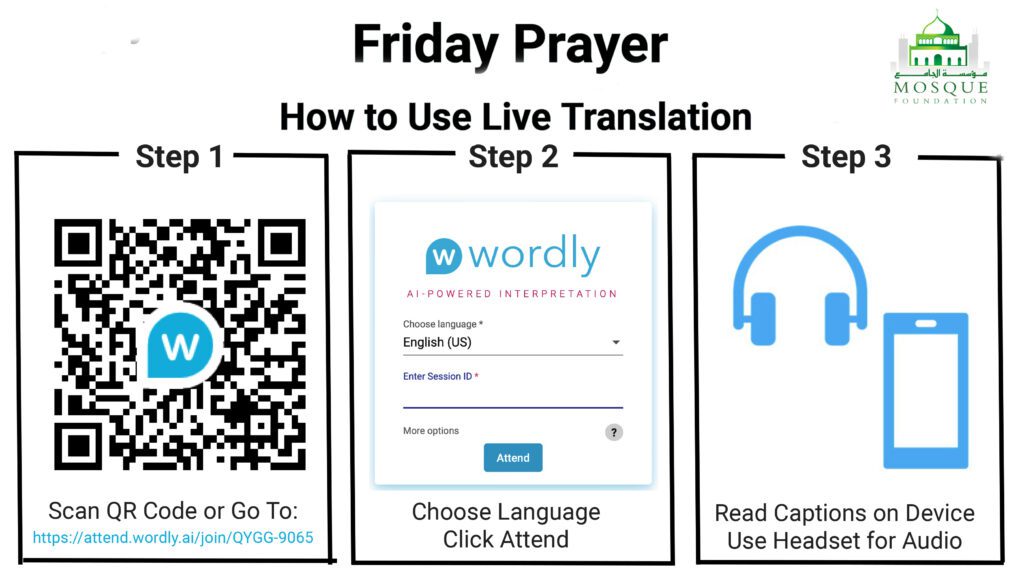
Friday Khutba Live Stream Translation

Join Live Stream Tranlastion. Fiqih Class and  Friday Khutba at 12:00 PM . It will be translated From Arabic to 57 languages including English, Spanish , French , Turkish , Albanian , Persian , Urdu , bengali and many more .

Follow these easy steps . All you need is a phone and headphones

  • Click the link :    https://attend.wordly.ai/join/QYGG-9065
  • Chose the Language of your choice and click attend.
  • Translation starts as text . For Audio Translation . unmute Speaker button (make sure you have headphones)                                      ******************************************************************************************************************

لائیو سٹریم ٹرانسلاشن میں شامل ہوں۔ فقہ کی کلاس اور خطبہ جمعہ دوپہر 12:00 بجے۔ اس کا ترجمہ عربی سے انگریزی، ہسپانوی، فرانسیسی، ترکی، البانیائی، فارسی، اردو، بنگالی سمیت 57 زبانوں میں کیا جائے گا۔

آسان اقدامات پر عمل کریں۔ آپ کو صرف ایک فون اور ہیڈ فون کی ضرورت ہے۔

لنک پر کلک کریں

 https://attend.wordly.ai/join/QYGG-9065

اپنی پسند کی زبان کا انتخاب کریں اور حاضری پر کلک کریں۔

ترجمہ متن کے طور پر شروع ہوتا ہے۔ آڈیو ترجمہ کے لیے۔ اسپیکر بٹن کو چالو کریں (یقینی بنائیں کہ آپ کے پاس ہیڈ فون ہیں) اور جادو کو شروع ہونے دیں

 *******************************************************************************************************

Únase a la traducción de transmisión en vivo. Clase de Fiqih y Viernes Khutba a las 12:00 p.m. Se traducirá del árabe a 57 idiomas, incluidos inglés, español, francés, turco, albanés, persa, urdu, bengalí y muchos más.


Siga los sencillos pasos. Todo lo que necesitas es un teléfono y auriculares.


Haga clic en el enlace:    https://attend.wordly.ai/join/QYGG-9065

Elija el idioma de su elección y haga clic en asistir.

La traducción comienza como texto. Para traducción de audio. Activa el botón del altavoz (asegúrate de tener auriculares) y deja que comience la magia.۔


Ramadan: A Journey of Spiritual Liberation and Divine Mercy

The Messenger of Allah ﷺ said: “There has come to you Ramadan, a blessed month, which Allah, has enjoined you to fast. In it the gates of heavens are opened and the gates of Hell are closed, and every devil is chained up. In it Allah has a night which is better than a thousand months; whoever is deprived of its goodness is indeed deprived” (Sunan an-Nasa’i).

Ramadan is a manifestation of divine beauty and love upon Allah’s servants. As we approach this sacred month, we should feel a profound sense of awe and inspiration at Allah’s generosity and beauty. Ramadan is not merely a time for fasting, praying, and reading the Quran; it is an opportunity to deepen our spiritual connection with Allah, embracing the profound love and beauty that this month offers.

The Messenger of Allah ﷺ said: “(Allah says) fasting is for me and I shall reward for it. The fasting person rejoices twice: when he breaks his fast and the day when he meets his Lord. And the smell that come from the mouth of the fasting person is better before Allah than the fragrance of musk.” (Sunan an-Nasa’i). This Hadith highlights that Allah is speaking to us about our breath. Allah’s deep awareness and care for us, even in the smallest details such as our breath. Allah acknowledges that leaving our desires is not easy and that our bad breath may not be pleasing to those around us. Just as only a mother and father can love the scent of their child or baby, Allah knows that our bad breath is an indication of our sacrifice and commitment to Him.

Allah tells us that Ramadan is the month when He sent down the words and guidance, He chose for us, indicating what He wants us to follow in life. There are countless choices and things we can do in our lives, but Allah assures us that His guidance is in our best interest. The Quran offers beautiful guidance, showing us how to practice self-discipline and rise above self-indulgence. We can thrive through hardship and difficulty, just like the Prophet, who remained loving and caring no matter how challenging the situation.

Allah tells us that through Ramadan, we can overcome our lower nafs every day. This is the most liberating experience, as our worst enemy is the lower nafs that command us towards evil. Allah’s mercy and love for us are evident in His provision of acts of worship, allowing us to overcome ourselves and learn more about our potential. Many of us doubt our potential and ability to be positive, spiritually elevated people. We lack confidence due to a negative outlook, often thinking that past Ramadans didn’t meet our expectations. But Allah assures us that He wants ease for us, not hardship.

If we fast Ramadan with belief and surrender, trusting Allah and embracing His love, He promises that all our sins will be forgiven. As our beloved prophet ﷺ mentioned, “He who fasts during Ramadan with faith and seeking his reward from Allah will have his past sins forgiven; he who prays during the night in Ramadan with faith and seeking his reward from God will have his past sins forgiven; and he who passes Lailat al-qadr [Night of Decree] in prayer with faith and seeking his reward from Allah will have his past sins forgiven” (Bukhari and Muslim).

Every night in Ramadan, Allah saves people from hellfire, offering endless rewards for every ritual. As our beloved Messenger ﷺ said, “At every breaking of the fast Allah has people whom He frees (from the Fire), and that happens every night” (Sunan Ibn Majah). As we approach Ramadan, let us do so with humility and the best opinion of Allah in our hearts. Let’s leave our past failures behind and not let them sour our experiences. Don’t doubt Allah’s mercy and His desire to ease your burdens.


By Imam Basheer Abdeen

Jan 30, 2025

Tips for Sincere Repentance

Whoever believes they are sinless has already erred, and whoever doubts Allah’s vast mercy has only deepened their sins. The righteous, when they commit a mistake, hasten to sincere repentance, fulfilling its conditions and reinforcing it with good deeds.
“Indeed, good deeds wipe out evil deeds” (Quran 11:114).
Repentance is about regret and transformation. If one sins with their hands, they should extend them in kindness. If they walk toward sin, they should walk toward righteousness. The best practice is sincere repentance.

“O you who have believed, repent to Allah with sincere repentance” (Quran 66:8).

The Prophet ﷺ said:
“All the sons of Adam are sinners, but the best of sinners are those who repent frequently” (Ibn Majah).
Even Adam, the first human, repented after his mistake, and Allah accepted his repentance.

Steps to True Repentance
Acknowledge and stop the sin. One cannot claim to repent while persisting in sin. Scholars say:
“No sin is small if done repeatedly, and no sin is too great if followed by sincere repentance.”

The Prophet ﷺ warned that minor sins accumulate until they destroy a person. To truly repent, one must halt the cycle of sins.

Genuine regret is an essential part of repentance. The Prophet ﷺ emphasized:
“Regret is repentance” (Ibn Majah).
This feeling should motivate efforts to avoid sin in the future.

A firm resolve never to return to the sin is necessary. This is achieved by eliminating triggers. If bad company leads to sin, it must be abandoned. If a place tempts one into wrongdoing, it should be avoided.

Ibn al-Qayyim advises:
“True repentance from a sin is by performing its opposite. If one sins with their tongue, they should recite the Quran. If they harm others with their hands, they should assist the weak. If they waste wealth on haram, they should give in charity.”

Restoring the rights of others is also crucial. If the sin involves harming others, repentance is incomplete without rectifying the harm. Seeking Allah’s forgiveness alone does not erase injustices against people. One must return what was taken or seek the forgiveness of those wronged.
Persistence in repenting, even if one sins again, is necessary. What if one repents but later sins again? The answer is simple: repent again!

Allah assures us:
“Indeed, I am most forgiving to those who repent, believe, and do good, and then remain guided” (Quran 20:82).

The Prophet ﷺ said:
“Indeed, Allah does not get tired until you get tired” (Al-Bukhari).

No matter how many times we fall, we must continue to rise and seek Allah’s mercy and forgiveness.
Let us take the path of sincere repentance. By acknowledging our sins, feeling regret, resolving not to return to them, restoring the rights of others, and persistently seeking forgiveness, we renew our bond with Allah.

By Imam Jafar Hawa

O Allah, Make Us Among the Mossaddaqeen

O Allah, Make Us Among the MossaddiqeenThere are many windows of opportunity in this life, especially placed by Allah , to purify our souls and gain forgiveness for our sins. These opportunities are open to every believing individual, young and old, poor and wealthy, ill and healthy, educated and illiterate. It matters not. Some take advantage of these windows, seeking them with every turn and twist in worldly life, both in happiness and calamity.

For these people called al-Mossaddiqeen, Allah has created a special level in the heavens for those who give Sadaqah consistently. It is the quality for which they are most recognized and is what will witness for them on the Day when nothing can attest for them but their deeds.

This group of people is the best at finding the best bargains and offers, constantly searching and consumed with the Best Deal—The deal granted by He Who created us and assigned provisions for us. Allah says, “Who will loan Allah a lofty loan which Allah will double unto their credit and multiply many times?” (Quran 2:245). The Mossaddiqeen grasped this deal because they recognized it is like no other that can be granted in this worldly life. My brothers and sisters, Allah has blessed us with provisions, and He asks that we give from what He has presented us so that He may provide us with more; how generous is Our Creator?

So even when it is challenging to give Sadaqah, the Mossaddiqeen remember that it does not decrease wealth. The Prophet stated, “Charity does not decrease wealth, and the servant who forgives, Allah makes him more respected; and the one who shows humility, Allah elevates him in the eyes of the people” (Muslim).

For this reason, the Mosque Foundation community’s perception of Sadaqah has gained great regard and esteem from other communities. Your sincere commitment to give from your wealth and possessions protects your families and will continue to bi’thinillah. To spend in Allah’s cause by propagating His religion is a charity with high merit and great reward. The one who spends in the cause of Allah will continue to be rewarded even after death. You provide a place to pray, a site to learn about religion, seek counsel, and to support the needy.

We must consider several requirements to ensure that our Sadaqah is accepted. First of all, Sadaqah must be given from money that is earned lawfully. Allah says, “Oh you who believe, spend from what you (lawfully) earned” (Quran 2: 267).

Second, when giving Sadaqah, the believer must purify their intention and make their purpose to gain Allah’s pleasure and reward. The Prophet said, “All deeds are based on intention, and everyone will be rewarded according to what he intended” (Bukhari).

Third, the believer should make haste in giving Sadaqah and should only delay it with a valid reason. It is also much better for Muslims to give Sadaqah when there is a need than to wait until death comes and it is too late. Prophet Muhammad was once asked about the best of all charities, to which he replied, “The best charity is what you give during your life while you are in need of it.”

Fourth, it is more befitting for a Muslim to give Sadaqah from their best possessions, which you love most. Allah says, By no means shall you attain righteousness unless you give (freely as a charity) from that which you love; and whatever you spend Allah knows it well” (Quran 3: 92).

However, this does not mean that one should lessen the value of their Sadaqah if they only have little to give. Prophet Muhammad once said to his companions, “One Dirham could be better in reward than one hundred thousand Dirhams.” A man asked, “And how is that, oh Messenger of Allah?” He replied, “A wealthy person takes one hundred thousand Dirhams, which is one part of their wealth, and gives it as a charity, while a poor person who only has two Dirhams pays one of them as a charity.”

By Sh. Jamal Said

Fasting and the Path of Taqwa


Rediscovering Ingredients Required for Developing Taqwa through Fasting

Is there a relationship between fasting and developing piety? According to the Quran, fasting during the month of Ramadan is closely tied with taqwa, a term usually translated as ‘piety or righteousness’ and derived, linguistically, from the concept of protection. It is not difficult to connect taqwa with the linguistic sense of protection since taqwa serves as a shield against falling into sin and suffering punishment in the Hereafter. 

However, the question is, ‘how does fasting lead to taqwa?’ Attempting to answer this seemingly simple question can help us recognize the prime purpose of fasting and create ways for us to evaluate our moral progress during the blessed month of Ramadan. Reflecting on the relationship between fasting and taqwa, we find that fasting provides us with the necessary ingredients for developing taqwa. The following is a brief outline of taqwa’s main components and how fasting helps us develop each. Some action points that can be used as a thermometer for measuring taqwa follow these components.

1-   Soul Care

           In his Ihya’, Imam al-Ghazali argues that our bodily desires are fueled by food and energy. Therefore, fasting weakens lust and desires temporarily to allow the soul to lead the body and communicate with Allah. When you break your fast at sunset, you prepare for Taraweeh and more prayers at the Masjid. Therefore, the Ramadan fast is both a defensive spiritual fortress and spiritual nourishment for the soul. 

In Ramadan, you are skipping a meal for a spiritual reason. Unfortunately, some people overeat during the ‘iftar period to make up for the meal they missed and may gain weight by the end of the month! Preparing healthy food and liquids for ‘iftar and eating with moderation is key to effective fasting. 

Action Point: I am committed to avoiding overeating during ‘iftar time since it is both unhealthy and negates the goal of less food consumption during Ramadan in skipping one meal a day. 

2- Willpower

You may believe that you cannot achieve great goals or break cycles of sinning, thinking that you are not strong enough to resist the temptations and difficulties facing you. However, during your fast, you are being trained to control and master your bodily desires. When your body asks you for food or water, you can say: NO! Fasting proves that you can get unstuck from destructive habits you have developed—because if you can stay away from essential halal matters, like food and drinks, you can easily stay away from haram terrible habits. 

Action Point: I am determined to fast from bad habits permanently. (Specify one or more sins you plan to abandon. Focus on the strength and willpower you developed in Ramadan and ask Allah to redirect your life to be closer to Him.)

3- Forgiveness of Sins 

Sometimes, people have driven away from taqwa due to their sin’s burden, which, they think, is too heavy to allow them to reach Allah. However, Prophet Muhammad ﷺ informed us that ‘whomsoever fasts the month of Ramadan with iman(faith) and ihtisab (expectation to be rewarded) will have his sins forgiven.’ Therefore, the fasting season is an excellent opportunity for repenting and renewing our relationship with Allah ﷻ. Allah ﷻ invites all sinners to repent, no matter what they have committed, stating, “Say [to people], [Oh Prophet], Oh My servants who have committed sins in great excess against themselves, never despair of Allah’s mercy; indeed, Allah forgives all sins. Indeed, it is He alone Who is the All-forgiving, the All-merciful” (Quran 39:53). A man asked Rabi’ah al-‘Adawiyyah: “Do you think Allah will forgive me after I had committed so many sins?” She immediately answered, “He invites those who are away from Him to repent. Do you think He will reject those who seek Him?” 

Action Point: I choose to turn to Allah and commit myself to Him. (The results of sinning include regret, shame, depression, damaged relations, etc. should serve as a deterrent and a means to motivate you to turn back to Allah.) 

4- Humility 

In fasting, we can recognize our human weakness and dependence on Allah. This recognition guards us against being deceived by luxury (no matter how little) we are surrounded with, as the Quran puts it, “Nay, man, does transgress all bounds when looking upon himself as self-sufficient!” (Quran 96:7-8)

Action Point: I am determined to humble myself before Allah and before people. (Have you ever seen a baby? Once you were one, having no power and no knowledge! Never use Allah’s blessings as a justification for arrogance; Allah’s blessings should make you more humble.) 

5- Patience and Gratitude 

Besides developing patience through a long day of Ramadan fasting, one also develops an attitude of gratitude. For example, for many, the most precious thing at sunset is simply a water bottle and a couple of dates. Fasting teaches us not to take anything for granted. Think of all the blessings Allah has bestowed upon you and your family as unique gifts for you. Do not allow people’s possessions of elemental benefits (like sight, health, shelter, etc.) to make you feel that you are not unique in sharing those blessings. Ramadan reminds us to recognize introductory provisions as unique. Thank Allah for the ability to drink clean water! This sense of gratitude will lead any sane person to the worship and obedience of Allah, Who is the source of our existence and survival. 

Action Point: I am determined to develop an attitude of gratitude. (Remember that observing Salah, thanking people, helping others, and acknowledging Allah’s blessings are all examples of demonstrating the value of appreciation.) 

6- Giving

In the Quran, the rights of Allah and the rights of people are connected. Notice, for instance, how Salah or ritual prayer (the right of Allah) is frequently associated with Zakah or charity (the right of people). In Ramadan, we feel the hunger and thirst of millions of people globally, thereby developing a strong sense of empathy for them. This empathy turns into action in Ramadan, a month of fasting, prayer, and giving. Giving purifies our hearts from greed and living a self-centered life.

Action Point: I am determined to pay my Zakah and give charity to the poor and the needy. 

7- Sincerity 

In Islam, for an action to be moral and accepted by Allah, it is not enough that the action is good. The motive behind the action has to be good, and the action has to be intentional for seeking the pleasure of Allah. This is called ‘Ikhlas, the opposite of Riya’; that is, doing something seeking people’s approval and praise, not Allah’s pleasure and glory. We stay away from food and drinks and other invalidators of fasting during our fasting even if no one is watching us. In doing so, we train to live in the presence of Allah and do good deeds to glorify Him alone.

Action Point: Fasting makes one more God-oriented. I am determined to fast Ramadan as a religious obligation to achieve taqwa and seek Allah’s pleasure, not as a cultural practice to impress others or gain their approval. 

8- Faith-filled Environment:

Being disconnected from your local mosque, lacking good friends, and abandoning benevolent acts may lower your level of faith. Ramadan is like an intensive course in good deeds: Taraweeh in the Masjid, sadaqah for the needy, annual Zakah, reading and studying the Quran, inviting people for ‘iftar, developing stronger family connections …etc. The creation of this faith-filled environment increases our opportunities to be more connected with Allah. 

Action Point: I am determined to disconnect from the harmful environment that leads me into sinning and replace it with developing more connections with the Masjid and good people. 

9- Dua’a

It is interesting to note that a Quranic encouragement to offer dua’a comes between two verses, which outline the fasting rules, emphasizing the relationship between fasting and dua’a. Recognizing our human weakness makes our dua’a more effective and sincere. The Quran states, “When My servants ask you about Me, then I am near. I answer the prayer of a supplicant when he calls upon Me. Let them obey Me and believe in Me so that they will be guided” (Quran 2: 186). Usually, the Quran uses the form,‘ If they ask you about …, say to them …” Yet, here Allah did not say to the Prophet ﷺ, ‘When my servants ask you about Me, say to them …’; Allah provided the answer directly to remove any intermediaries between Him and His servants. We can communicate with Allah ﷻ directly.

Action Point: I am determined to prepare some dua’a to be said each day, and I trust the way and the time Allah answers them.

10- Closeness with the Quran 

If I asked you to define Ramadan, how would you answer? The month of fasting? That is correct. Yet, Allah described the month of Ramadan as “the one when the Quran was revealed” (Quran 2:185). The revelation of the Quran is the reason why we celebrate the month of Ramadan, and the way we celebrate it is by fasting to develop a closer relationship with our Creator. Thus, if we do not improve our relationship with the Quran, we will fail to understand what the month of fasting is all about. 

Action Point: I am committed to the following duties towards the Quran:

  1. A) Reading: Imam Malik used to leave his Hadith books in Ramadan to focus more on the Quran.
  2. B) Understanding: Failing to understand the Quranic message will leave the reader with nothing to inspire or motivate them. Once, the Prophet ﷺ spent all of his night prayers reciting one verse (Quran 5:118) due to his deep contemplation. 
  3. C) Memorizing: Quran is the ONLY sacred Book in the world that is memorized from cover to cover. Take part in this blessed practice and start, at least, with some selected verses or surahs to memorize in this holy month. 
  4. D) Applying: Make the Quran part of your life by putting its great values into practice.
  5. E) Spreading: Make sure that you teach others what you learned. Teaching your child a surah or more would fulfill this requirement.

Finally, I pray that you all experience a blessed Ramadan full of mercy and forgiveness. May Allah ﷻ keep us all guided on His Straight Path and united in obeying Him ﷻ. 

Ameen. 

By Sh. Ahmed Arafat


Fasting and Spiritual Maturity

Fasting is not starvation; it is a spiritual discipline that awakens our Fitrah, or natural disposition toward God, and keeps in check different negative traits of our human ego. Thereby, through mindful fasting, our souls can transform from a soul that has become accustomed to evil tendencies to a serene soul firmly aligned to the Straight Path. Failing to manage the negative traits of our ego may corrupt our Fitrah and impede our journey to God. This brief article outlines negative characteristics (red flags in our spiritual journey) and describes how fasting can strengthen our immunity to the intense appeal of developing such traits.

Red Flag 1: “Nay, man does transgress all bounds, when looking upon himself as self-sufficient!” (Quran 96:7-8). 

It is easy to be deceived by the luxury we have, the technological advancement we enjoy, the military power we develop, or the medical services we are offered. Some may unconsciously feel that they do not need Allah, and others may act as gods! However, none of these material advancements will change our big human reality; that is, we have a built-in need for our Creator, who makes our very existence possible. Instead of expressing more gratitude with authentic humility and love, we sometimes get overwhelmed with the gifts we forget or even deny the Giver!

Fasting offers a spiritual exercise to fight back any potential arrogance or egotism from focusing on the gifts. It does this by compelling a break from these gifts and reflecting on how our life looks with Divine Providence. To al-Ghazali, we receive an opportunity to develop more humility through mindful fasting and temporary hunger and keep our ego in check. We recognize how fragile and weak we become in the absence of some morsels and water. Furthermore, Ibn al-Qayyim beautifully depicts the different stages humans experience, starting from the moment of birth to the zenith of youth. Having talked about our helplessness and fragility as babies, Ibn al-Qayyim is puzzled over how our behavior changes as our different faculties and powers are developed. He writes: “As God perfects our hearing, sight, and reason and as He makes the universe subservient to us, we poor humans start to think that we have a share in this kingdom and look at ourselves with different lenses. We even forget our early state of helplessness, poverty, and need as if we never experienced these features and as if we are different creatures!” Look at a baby and observe its need and helplessness. Now, recognize you were one before!

Al-Ghazali asserts that if we fail to recognize our humility and limitations, we will undoubtedly fail to acknowledge the Divine power and sovereignty. The Quran awakens the arrogant by depicting a big irony: “He created man from a sperm-drop; yet behold he become an open opponent!” (Quran 16:4) The word yet in this translation is (إذا idhaal-fujaiyyah) in Arabic, which is better translated as “suddenly” or “unexpectedly” as an unexpected behavior usually follows it. Once we deny our human weakness and limitations and think of ourselves as gods, we will always see the doors of guidance closed! The Quran reads: “I shall turn away from My Signs those who magnify themselves wrongfully in the earth, and if they see each token believe it not, and if they see the way of righteousness choose it nor for (their) way, and if they see the way of error choose if for (their) way. That is because they deny Our revelations and are used to disregard them” (Quran 7:146).

When I said earlier that fasting is an exercise, this was literal. No one can say that it is meaningless for armies to carry out a series of tactical activities to stimulate war conditions. Similarly, fasting is like a spiritual maneuver that prepares us to face difficult times and challenging situations with patience, love, and support. Instead of lamenting others for the trials we experience, we are trained to be more mature: to resort to Allah with a humble heart and stand by the oppressed.

In Islam, we believe that this worldly life is not supposed to feel perfect. It is difficult. It is a test. It is short. However, that does not mean that life is horrible. It all depends on our attitude. Difficulties and trials in life do not signify that Allah abandoned us. It is a chance to approach God with a heart that has surrendered optimistically, not in rebellion, despair, or depression. In communicating with Allah about their trials and heartbrokenness, some early Muslim awliya experienced so much spiritual joy that they forgot about their problems and wished their state of heartbrokenness would remain!

Take, for example, this Hadith, which illustrates that trials do not mean that God is not in control. Instead, we have the responsibility to demonstrate actions that align with great values like hope, generosity, courage, and sympathy. These great values typically do not manifest except in trials and difficulties. Imam Muslim reported that: “Allah will say on the Day of Resurrection: O son of Adam, I fell ill and you did not visit Me. He will say: O Lord, and how could I visit You and You are the Lord of the worlds? He will say: Did you not know that My servant So-and-so had fallen ill and you did not visit him? Did you not know that had you visited him, you would have found Me with him? O son of Adam, I asked you for food, and you did not feed Me. He will say: O Lord, and how could I feed You and You are the Lord of the worlds? He will say: Did you not know that My servant So-and-so asked you for food and you did not feed him? Did you not know that had you fed him, you would surely have found that (the reward for doing so) with Me? O son of Adam, I asked you to give Me to drink, and you gave Me nothing to drink. He will say: O Lord, how could I give You to drink when You are the Lord of the worlds? He will say: My servant So-and-so asked you to give him to drink, and you gave him nothing to drink. Had you given him to drink, you would have surely found that with Me.” Similarly, the reward for accepting unchangeable trials with humility is gaining Divine support and tranquility.

Red Flag 2: “And few among my servants are the truly thankful” (Quran 34:13).

The power to see, hear and understand and the availability of water and basic food are among the Divine blessings that we would never trade. Why do many forget to thank Allah for these indispensable favors? Simply because they unconsciously feel that countless people enjoy the same blessings, they do not feel special! Here comes fasting to teach you not to take anything for granted and deal with each blessing as a special favor. To many, the most precious thing at sunset is simply a water bottle and a couple of dates.

Red Flag 3: “And you love wealth, you love wealth ardently” (Quran 89:20).

In Ramadan, we can feel the hunger and thirst experienced by millions of people worldwide, thereby developing a strong sense of empathy for them. This empathy turns into action in Ramadan in the form of giving. Giving purifies our hearts from greed and living a self-centered life. In the Quran, the rights of Allah and the rights of people are connected. Notice, for instance, how Salah or ritual prayer (the right of Allah) is frequently associated with Zakah or charity (the right of people).

Red Flag 4: “The love of desires is made alluring to people …” (Quran 3:14).  

In his ‘Ihya,’ Imam al-Ghazali argues that our bodily desires are fueled by food and energy. Therefore, fasting weakens lust and desire temporarily to allow the soul to lead the body and communicate with Allah. This is a lesson in self-discipline and self-control. One is trained to be the master of the body, not the other way around. So remember that you are skipping a meal for a spiritual reason. Unfortunately, some people overeat during the ‘iftar period to make up for the meal they missed and may end up gaining weight by the end of the month!

Red Flag 5: “If only I had not taken so and so as a friend. He led me away from the Revelation after it reached me. Satan has always betrayed humankind” (Quran 25:28-29).

Tell me who your friends are, and I will tell you who you are! This indicates the importance of whom we choose to associate. Lacking good friends, being disconnected from your local mosque, and abandoning benevolent acts may place your faith at significant risk. Ramadan is like an intensive course in good deeds: Taraweeh in the masjid, sadaqah for the needy, annual Zakah, reading and studying the Quran, inviting people for ‘iftar, developing stronger family connections …etc. This faith-filled environment increases our opportunities to be more connected with Allah.

Red Flag 6: “When they [hypocrites] stand up to pray, they do so sluggishly, showing off in front of people, and remember God only a little” (Quran 4:142).

In Islam, for an action to be moral and accepted by Allah, it is not enough for it to be good. The motive behind the action has to be good, and the action has to be done for a good intention: for God. This is called ‘ikhlas, the opposite of which is riya‘ (doing something seeking people’s approval and praise, not Allah’s pleasure and glory). While fasting, we stay away from food and drinks and other invalidators even if no one is watching us. In doing so, we train to live in the presence of Allah and do good deeds to glorify Him alone. 

By Sh. Ahmed Arafat